
Three-Handed Preflop In The Small Blind
The small blind is one of the most difficult positions to play in poker, and it’s no different in Spin & Gos. You will always be out of position postflop, which makes it difficult to navigate the small blind. There’s also going to be a lot of adjustment based on your opponents.
With that said, let’s take a look at three-handed preflop Spin & Go strategy from the small blind, from general rules to specific GTO ranges for common spots such as playing against a button raise and opening against the big blind.
Small Blind Versus Button Raise “Rules”
As mentioned, you’re going to be making a lot of opponent-specific adjustments from the small blind. Keep that in mind as you study ranges. Still, there are some general rules you can follow to keep you on track when playing against a button raise:
- You should very rarely flat, as doing so will leave you out of position and also incentivize the big blind to either call or raise. For the most part, you’ll be three-betting, moving all in or folding.
- With 20 big blind effective stacks or lower, you’ll usually be moving all in or folding against a button raise.
- As stack depths get shallower, you range will widen to include more shoves and you’ll have even less options when it comes to flatting or three-betting.
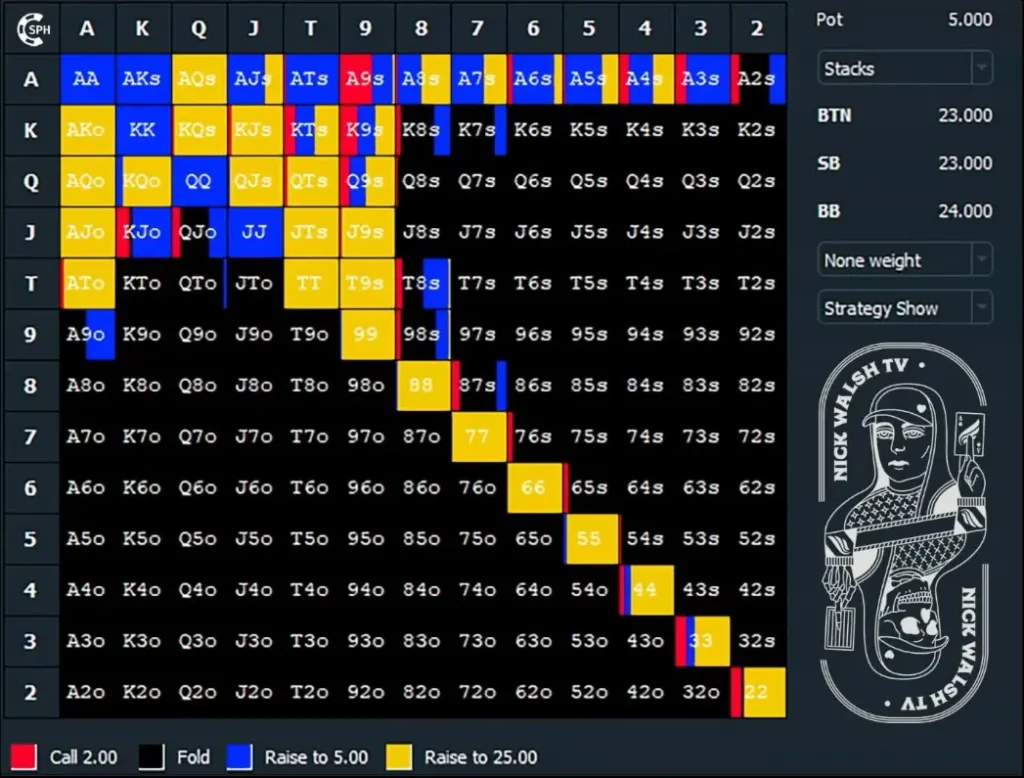
Versus Button Steal 25bb Effective
With a 25bb effective stack, your all in ranges against a button steal includes 22-TT /ATo+ /A8s+ /KJs+ /QTs+ /J9s+ /T9s+. That’s a fairly wide range of pairs, aces, broadway hands and some strong suited connectors.
You can also three-bet to 5bb with some of your strongest hands, such as with AA-JJ and AKs, rather than shoving. This allows you to get more action with these premiums, as you don’t want players to fold all their hands. If playing against competent opponents, this needs to be balanced with a few bluffs like weak suited aces to balance your range.
GTO does have a small selection of hands that you can profitably flat with at this stack depth, although for the most part these calls are infrequent and not crucial to a profitable range.
Take a look at the 25bb small blind ranges versus a button open below. In terms of adjustments, you don’t need to deviate too much from the pre-defined GTO ranges. However, you won’t have to balance your three-bets against weak opponents. Instead, just three-bet strong hands and either shove or fold the rest.
Versus Button Steal 20bb Effective
As the stack sizes hit 20bb effective, the overall range of hands played is not too dissimilar. The main difference is that you’ll be moving all in with a greater number of hands and absolutely never flat calling.
When it comes to three-betting, GTO ranges suggest only three-betting your very strongest hands, in this case Aces and Kings, balanced by one or two bluffs with suited aces. Again, there’s no need to balance against weaker opponents.
As an adjustment, you can three-bet a few more hands, such as QQ and JJ, against weaker opponents who will call with worse. You may also want to add a few weaker combos, such as A8o and A7o, if your opponent is overfolding.
Take a look at the small blind versus button steal 20bb range to get a feel for how it widens compared to 25bb:

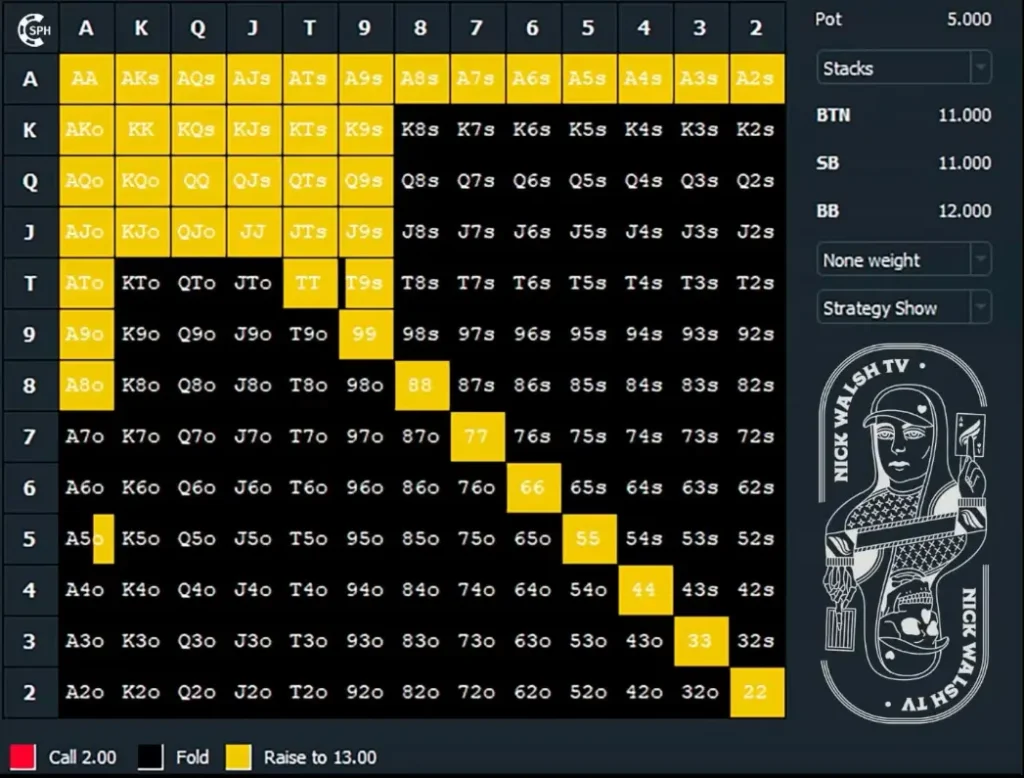
Versus Button Steal 10bb Effective
With 10bb effective, you have an even wider shoving range with absolutely no flat calling or three-betting. Just shove or fold. Your shoving range consists of hands from your 20bb charts, along with a few others like KJo/QJo/A8o.
Strategy is pretty straightforward here and only minor adjustments are needed to account for maniacs of tight players on the button. You can also adjust for the big blind’s stack and tendencies, by flat calling strong hands, for example, as a trap to induce a shove.
Here are your 10bb GTO ranges for the small blind against a button steal:
Small Blind Versus Button Shove
Before we move on to the complicated subject of playing against the big blind, let’s briefly touch on playing from the small blind against a button shove, so that you can see the kind of ranges you should be calling with according to effective stack sizes:
- With 25bb effective, call with 44+/ATs+/ A9o/ KQo/ KJs+
- With 11bb effective, call with any 22+/A7o+/A4s+/KTs+/KJo+
You’ll see here that, again, your ranges with 11bb are much wider than at 25bb stacks. There’s not too much to consider here. These GTO ranges are unexploitable, so they play well against solid opponents and those who are shoving too tight or wide.
As always, though, you should be prepared to adapt to the table. Widen your ranges against maniac shovers and tighten them slightly against button shoves from tight players.
Small Blind Versus Big Blind “Rules”
Playing from the small blind against the big blind is a very complicated situation and entire books have been written about it. Keeping it relatively simple for now, here are some of the main “rules” to keep in mind when playing this spot:
- Larger preflop raise – You’ll want to win more pots preflop by stealing from the small blind, rather than getting called every time by the big blind. A larger raise size is generally more suitable.
- Raise size varies – You can even vary your raise size according to effective stacks. We recommend a 3bb raise with 22-25bb stacks, 2.5bb raise with 15-21bb, and 2bb with 14bb or less.
- Range includes limps – Limping is a major part of small blind versus big blind strategy. It allows you to play more hands effectively by limp-calling, rather than getting raised off medium strength hands. You can also lay traps with very strong hands by limping.
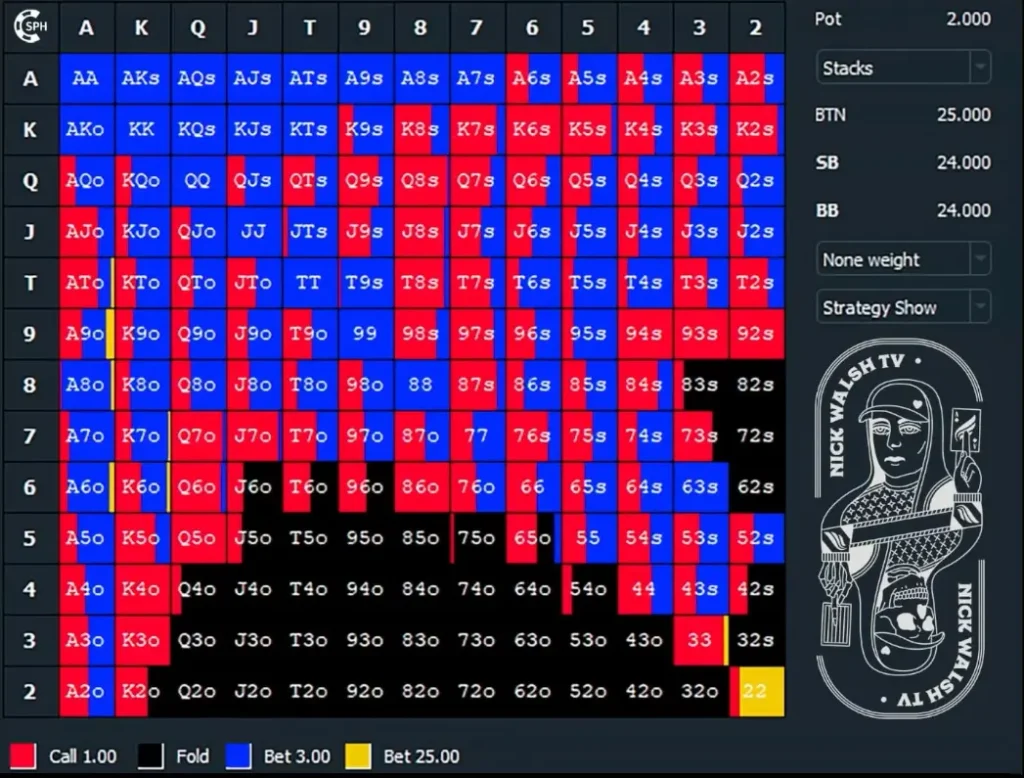
Small Blind Versus Big Blind 25bb Effective
At the 25bb stack depth, you’ll be playing a very wide range of hands with a mixture of limps, raises and folds. Don’t worry too much about frequencies or balancing ranges against weaker opponents or low stakes player pools. If in doubt, tend towards raising the range or adjust according to other players.
You’ll be limping a lot of hands like small pairs and medium strength hands like KTs, balancing your limps with a few stronger hands like AJ and AT. This gives you much more flexibility compared to open-raising your entire range, as you’ll have the option to limp call or limp shove.
Take a look at the GTO table below to familiarise yourself with opening ranges against the big blind:
Versus Big Blind Raise or Shove Over Limp 25BB Effective
If you limp into the pot and the big blind raises, you’ll still be able to call with a lot of your limping hands, folding out the weaker combinations and shoving some of the low pairs and suited ace type hands.
When the big blind shoves all in over your limp, your calling range will mostly consist of strong hands such as pairs, suited aces, strong offsuit aces and so on. GTO also recommends calling some hands like JTs here, but in reality you can make a general adjustment of sticking to only strong hands when calling a shove.
GTO range charts are available on the video for these spots.
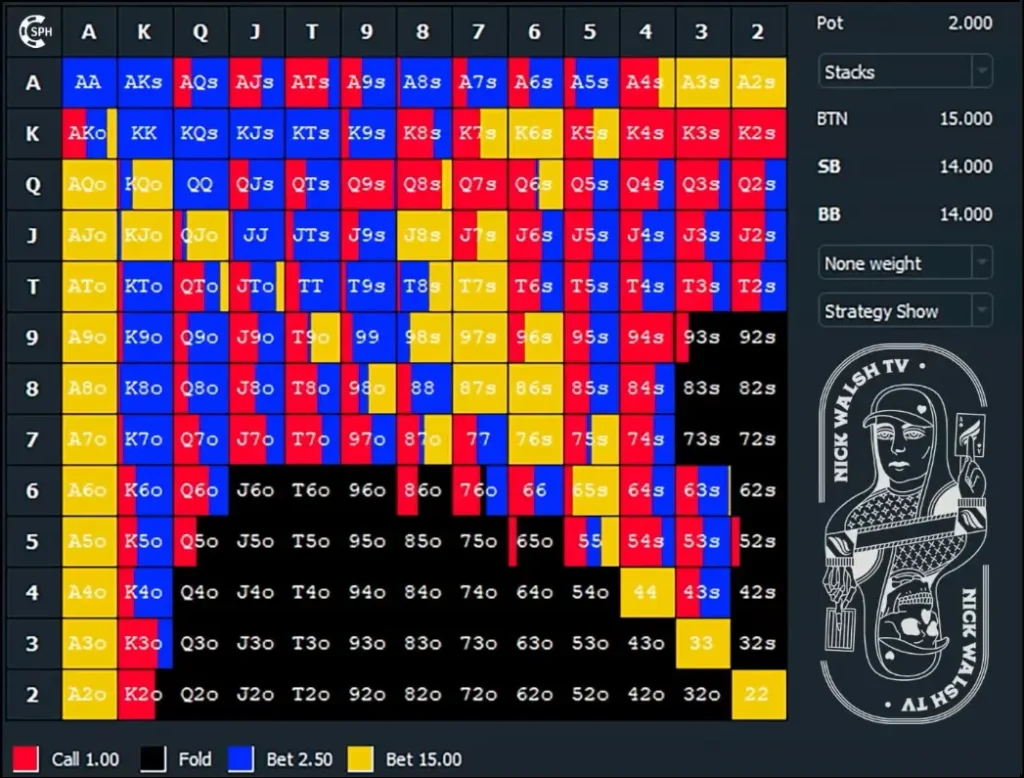
Small Blind Versus Big Blind 15bb Effective
With 15bb effective stacks, you’ll be open-shoving all in with a wider range that includes all small pairs, most offsuit aces, strong suited connectors, as well as hands like KQo and KJo. These shoves are unexploitable, as your opponent will always need a certain strength of hand to profitably call and they don’t pick up these hands often enough.
You can still raise with your premium hands rather than shove, balancing this with a few weaker hands if necessary. Likewise, there’s still room to limp some weaker hands, balancing with stronger limps.
As an adjustment, you can raise some of these shoving hands if your opponent overfolds or rarely three-bets or even limp more hands to outplay them postflop.
Here are the GTO ranges for this spot with 15 big blinds:
Again, if the big blind raises over your limp, you can continue by limp-calling with quite a lot of your range. If they shove over your limp, you’ll generally only call with strong hands. (Ranges available on the Spin & Go video lesson).
Small Blind Versus Big Blind 10bb Effective
With 10 big blind effective stacks, we are back to shoving pretty much our entire range from the small blind against the big blind. You can also min-raise your very strongest hands for value, as always, balanced with bluff raises if needed.
Not many adjustments are needed here. In general, you won’t need to balance your ranges against a weaker field, so you can just fold your trashy hands, raise premiums, and shove everything in between.

Next Lesson…
It’s been a complicated lesson studying one of the most complex spots in online poker. Playing from the small blind is not easy and you’ll need to constantly adjust your ranges based on stack sizes and opponents. Watch the training video to get into more detail. Next time, we’ll be covering playing preflop from the big blind.







View Other Blogs