
Starting Hands in Poker
What is a starting hand in poker?
In a game of Texas Hold’em, each player is dealt two cards that are seen and used only by that player, known as their hole cards. Your hole cards are your starting hand in poker.
Eventually, you’ll see five more collective cards, known as community cards, dealt on the flop, turn and river. Before this happens, though, the strength of your starting hand determines whether you should enter the pot at all.
Stronger starting hands, by definition, win at showdown more often than weaker ones. They provide more equity in the pot and viable ways to realize that equity.
Pocket aces is at the top of the strongest hands in Texas Hold’em. It will win out over a weaker pair around 80 percent of the time and almost 92 percent of the time against AK. The problem is, you’ll only be dealt pocket aces an average of once every 221 starting hands.
Another issue is, you can’t always sit around waiting for strong hands, especially in tournaments when the blinds will eat away at your stack. Instead, you’ll need to have a range of poker starting hands, which will depend on factors like position.
In this guide, we’ll take you through Texas Hold’em starting hands, hand groups, and show you the types of starting hands to play depending on position.
Types of poker starting hands
Texas Hold’em starting hands can be broken down into categories. Understanding these categories allows you to identify which starting hands are playable. This is known as your starting hand selection.
Here’s a breakdown of the main types of hands in Texas Hold’em:
Pocket Pairs
If your hole cards form a pair, known as a “pocket pair”, then you already have a hand one step up the hand rankings ladder. Pocket pairs can often win a hand of Texas Hold’em without improvement, although this depends on the size of your pocket pair.
On average, you’ll be dealt a pocket pair once every 16 hands. Pocket pairs can be broken down into several categories. High pairs, such as pocket aces or pocket kings, play differently to small pairs like pocket deuces.
The biggest pocket pairs often qualify as monster hands, while smaller pairs can be considered speculative at best.
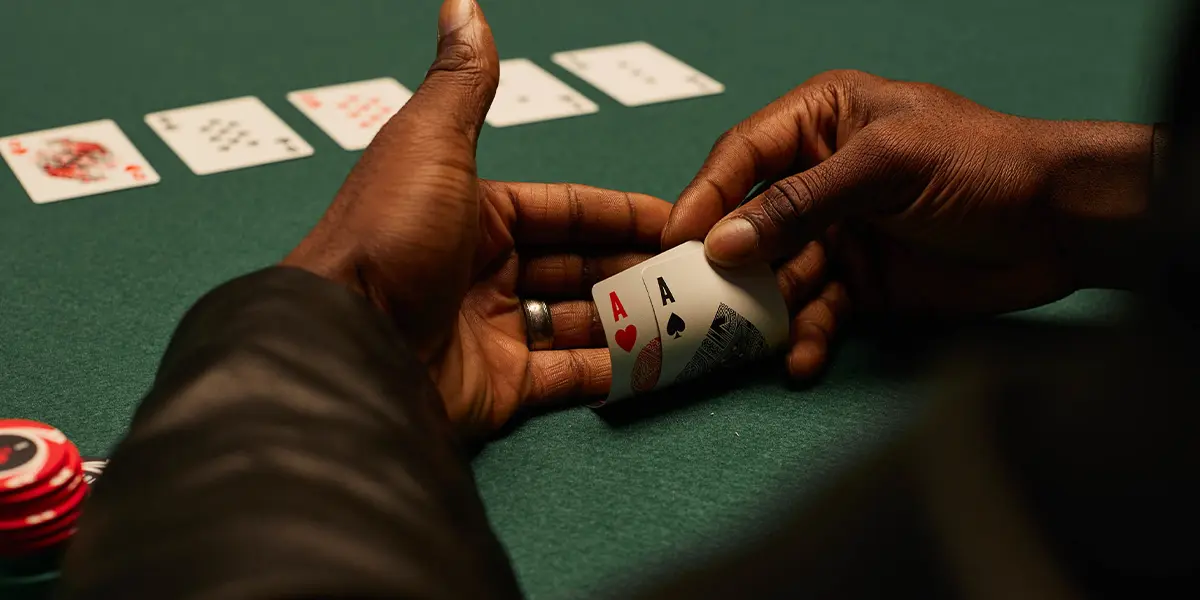
Premium Pairs – High pocket pairs, such as pocket aces, pocket kings, pocket queens and jacks, are known as premium pairs. They are the best poker starting hands in the game. They dominate all other pairs and beat most broadways. If you are holding pocket kings, for example, your opponent has to make a pair of aces in order to beat you. You should nearly always raise or re-raise with a premium pair, even from early position.
Medium Pairs – Medium pairs start from pocket tens and run down to pocket sevens. They are a great starting hand, but can lead to trouble when overcards fall on the board. When this happens, you’ll have to be prepared to navigate tricky spots with medium pairs. Still, they play well on low boards and can improve to a set.
Low Pairs – Low pairs from deuces to sixes are not strong hands. They can be dangerous if they do not improve. It’s likely that you’ll run into an overpair or overcard on the board, in which case you’ll often need to fold. The main use for low pairs is to set mine, i.e. to attempt to win big pots by hitting a set on the flop.
Broadway hands
The other category of particularly strong starting hand groups is Broadway hands. Broadway cards are ace, king, queen, jack and ten, so a Broadway hand includes two of these cards.
Premium broadways include ace king and ace queen. They often have other hands dominated and warrant aggressive play, such as a raise or re-raise preflop. They also play very well postflop.
Other strong Broadway hands include king queen, king jack and queen jack. Although they can be dominated by a better hand and therefore require more care to navigate.
As with any of the hand groups, suited hands are much better than offsuit hands. They have the additional chance of hitting a big flush or to semi-bluff with a draw and overcards.
Other suited hands
Suited connectors – Suited connectors offer multiple ways to win big pots. They consist of running cards of the same suit, such as JTs, T9s, 98s, and so on, allowing you to hit straights, flushes, two pairs and big draws. Outside of premiums and broadways, higher suited connectors are one of the most viable types of poker starting hands.
One-gappers – One-gappers are similar to suited connectors. But they are weaker because there’s a gap between the running cards, such as J9s, T8s, 97s, and so on. This makes it less likely overall that you’ll hit a straight. Still, one-gappers play fine from late position if the situation is right.
Suited aces – Aces with weak kickers are generally not a great hand as they are too easily dominated. Suited aces, however, have the chance to hit nut flushes or nut flush draws, along with pairs. This makes them a stronger and more playable poker hand from late position. Low suited aces such as A3s can also play well because they can hit the wheel straight.
Other offsuit hands
As mentioned, offsuit hands are not as strong as suited hands in Texas Hold’em. A poker player who chooses too many offsuit hands, especially from early position, is likely to land in more trouble. Still, there are a selection of offsuit hands that are still worth playing
Broadways – Premium broadways like ace king and ace queen are worth playing from early position, middle position or late position, even if they are offsuit hands. You can usually raise or re-raise with most broadways, even lower end hands like QJ, from late position.
Connectors – Offsuit hands that are connected can still provide some value in the form of straights, straight draws or pairs. This makes it possible to raise with hands like jack-ten and jack ten from late position, or to defend the big blind with these hands.
Trash – Now we get to the weakest of the starting hand groups, absolute trash. Examples include 95o, Q5o, and the worst of them all, 72o. Whether suited hands or offsuit hands, these cards are rarely worth playing as part of your hand selection. If you are dealt trash in poker, the best move is to fold.
Evaluating poker starting hands
For a new poker player, unless you’re dealt starting hands like pocket aces or pocket kings, it can be difficult to decide which hands to enter the pot with. Strong hands are easy enough to play, and weak hands are easy enough to fold, but hands in the middle of the pack can be confusing.
Soon, we’ll show you how to adapt your hand selection based on position at the table. For now, here’s a quick guide to evaluating poker starting hands.
Before you play a hand, ask yourself these questions:
Do I have a premium hand?
Strong hands are easy enough to spot and also the simplest to play. If you have a huge pair, or a premium Broadway hand, then you should nearly always raise or re-raise to build a big pot. This is true of hands like aces, kings, ace king and so on.
What rank are my cards?
The most important advantage of having higher unpaired cards than your opponent, is that you have a higher chance of winning if you hit a pair. Or if nobody hits a pair. For example, A♥K♣ holds a very strong lead over Q♠J♣ before the flop, and the worse hole cards have to improve from the start.
It also pays to have two high cards so that you have the better hand when it comes to the kicker. For example, if you get into a hand with A♠Q♥ and hit a pair, you can win a big pot from an opponent who has a weaker kicker, such as A♥J♠. They will struggle to fold and pay you off.
In general, the higher ranked both of your cards are, the better the hand.
Are my cards the same suit?
Having suited cards is the next most important consideration. Starting with two cards of the same suit gives you a higher chance of making a flush. You’ll only need three cards of the same suit on top of your hole cards to make a flush.
Additionally, you can be more comfortable when you’ve made a flush using both of your hole cards. The hand will be well disguised and you won’t have to worry as much about opponents having a higher flush as you would with four of the same suit out on board.
As an extra bonus, suited hands will give you more opportunities to bluff. You don’t always have to actually hit your draw to win a big pot. You can semi-bluff with your draws and take down the pot when the other poker player folds.
Are my cards of a similar rank?
Having cards of a similar rank is less valuable than a flush draw, but can be a decisive factor nonetheless. With closer-ranked cards, especially if they are directly connected, you’ll have a better chance of making a straight.
These factors combine. For example, if you have two connecting cards of the same suit, known as a suited connector, you’ll have multiple chances to win the pot by hitting the board.
Additionally, if your cards are high, you can hit the top end of the straights, the higher flushes, and win pots with pairs. Take ace king suited, for example, which is the strongest holding outside of a pocket pair.
Is my hand too weak to play?
There’s no shame in folding, especially when it comes to starting hands in Texas Hold’em. Having a well balanced range and never playing trash is one of the most immediate ways to improve your win rate.
Take a hand like seven-deuce offsuit, the weakest hand in poker. With this hand, you can’t use both hole cards to make a straight or flush, and any one pair hand you make will be very vulnerable.
When deciding on your starting hand, always ask yourself whether the best option is to fold. And always fold trash.
Why is position important for starting hand selection?
By now, you’ll have an understanding of Texas Hold’em starting hands, how they break down into categories, and which hands are strong or weak.
Now for the next step. The strength of starting hands actually changes according to a number of factors. Things like stack size, opponents tendencies, and especially position.
Position has so much impact on your starting hand selection in poker. It determines which hands you will play, raise with, re-raise with and so on. It’s not that the value of the hand itself changes, just that hands become more playable from late position.
The reason for this is that being in position offers a huge advantage. Preflop, you can see how many players fold or raise before making your move and only have to worry about the players in the small blind and big blind.
Postflop, being in position allows you to act last on every street. You can see what your opponent does and decide whether to keep the pot small with checks and calls, or inflate it with a raise or re-raise. The benefit of this cannot be overstated.
Starting hands based on position
You don’t have to worry about position too much when you have premium starting hands. They are strong enough that you can raise them from early position, middle position or late position.
However, your starting hand selection should change as you move from early position to late position.
From early position, you’ll want to stick mostly to strong hands. Late position is the time for aggressive play. From the button and cutoff in particular, you can loosen up your game and widen your starting hand ranges.
Starting hand ranges in early position
From early position, it is very likely that at least one other player will call or raise your bet. Unless they are in the small blind or big blind, your opponent will have position over you postflop, giving them the advantage.
It’s for this reason that your early position hand ranges should be very tight. An example of a tight under the gun range consists of mid to high pocket pairs, premium broadways, and a few top suited connectors. From early position, you should only raise around 10 percent of hands.
Starting hand ranges in middle position
From middle position, you can start to open up your starting hand selection a little bit. You’ll have less players to act behind you who could either wake up with a hand or take position. This also gives you more chance of stealing the blinds or playing against the big blind when they defend.
What’s a typical middle position range for a nine-handed table? Known as the lojack position, it includes the early position hands, plus any pair, suited aces. It also includes suited connectors and top end one-gappers. This represents around 15-20 percent of starting hands.
Starting hand ranges in late position
From late position, such as on the button, cutoff or even hijack, you can start to widen your range of starting hands quite dramatically.
From the button, if anyone has entered the pot before you, you’re guaranteed to take position if the hand goes postflop. If everyone has folded, you can open-raise with a wide range of starting hands.
This includes all hands that you would raise from middle position. Plus any ace, most suited kings, some suited queens and jacks, offsuit hands like K9 and Q9, and most suited connectors and one-gappers. You’re only really folding trash with no potential.
The impact of position is so dramatic. You can open-raise around 50 percent of hands from the button. Potentially even wider depending on the strengths and weaknesses of the players in the small and big blind.
