
Poker Positions Explained
Poker positions determine the order in which players act. Position refers to your current “seat” at the poker table. The dealer button moves and positions rotate after every hand, so that each player takes turn in every position during an orbit.
Beyond this, position is one of the most important factors in poker strategy. It’s so crucial to the game that it determines the range of starting hands you should play. Generally, you’ll stick to a very tight range from early position and a wider range from late position.
The button is the most desirable position at the poker table. It guarantees that you will act last during postflop betting rounds. It allows you to see how your opponents act and gain more information.
This guide will walk you through all aspects of position in poker. From discovering the best position and worst position, to learning poker strategy. All so you understand how to take advantage of playing in position.
Positions in poker
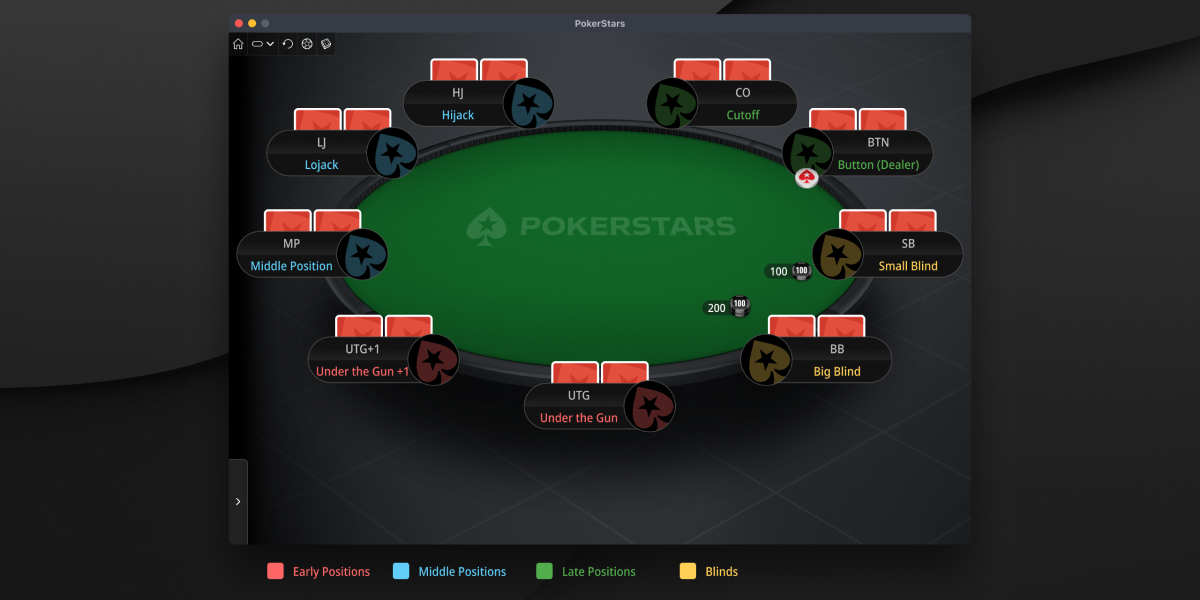
A nine-handed poker table is divided into early, middle and late position. There’s also the small blind and big blind, who have a category of their own but are technically early positions.
The Blinds
The players in the two seats to the left of the dealer are known as the blinds. They must both pay a compulsory bet before even seeing their cards. The big blind pays one big blind, while the small blind pays half a big blind.
The blinds are among the worst positions at the poker table. Not only are you forced to pay a bet, but you also act first on the flop, turn and river. So you are at a disadvantage against other players in the pot.
Players in the blinds, particular the big blind, will often have the pot odds to call a preflop raise. But the disadvantage of being out of position on the flop, and subsequent betting rounds, should be kept in mind. It can easily outweigh the favorable pot odds.
Early Position
“Early Position” describes poker players at the table to the left of the big blind. Specifically the players under the gun (UTG) and UTG+1.
Early position players are among the first to act in the preflop betting round. They will often be out of position against their opponents from the flop onward. This makes it the least desirable of the poker positions.
Poker players in early position have very little information about what their opponents intend to do. It makes it much harder to navigate even common poker spots. From early position, then, hand ranges tend to be very tight, as it’s simply too risky to play marginal hands.
Middle Position
“Middle position” (MP) is defined as seats between the player UTG+1 and the seat to the cutoff’s immediate right. Sometimes, the hijack is counted as late position because it allows more opportunity to raise.
Before the flop, players in middle position can loosen their starting hand requirements. Compared to early position they have fewer players left to act behind them. However, there remains a risk that late position opponents still to act gain the advantage by calling or raising.
If they do, you could still find yourself out of position from the flop onwards. So, middle position is the time to loosen up a little and of claiming position. Without getting out of hand when players act behind.
Late Position
“Late position” is by far the strongest position at the poker table. It includes the dealer button, which is the best position in poker, along with the seat to the immediate right of the dealer, known as the cutoff. The hijack is also sometimes categorized as one of the late poker positions.
From late position, most players have already acted before you preflop, allowing you to raise with a much wider range of starting hands. If players in the blinds call, you can play in position after the flop with a big advantage.
This allows you to play with marginal hands and speculative hands from late position. That’s something that we’ll cover in more detail soon.
Advantages of playing in position in poker
As mentioned, position is very important. Not only to determining the order of play at the table, but also for poker strategy. It significantly alters starting hand selection preflop, which we’ll cover in detail soon.
First, let’s explore why position gives you such a huge advantage over opponents after the flop:
Additional information
As the player who acts last you can see how all other players act before making your own decision in each betting round. This gives you a huge advantage in terms of information. You can more easily get a sense for their hand strength and act accordingly. All other advantages that come from position are a result of this extra information.
Pot control and free cards
If you have position in poker postflop, you’ll be the player who can close the action as the last player to act. If you’re unsure about a hand or could be behind, you can keep the pot relatively small. Either by flat calling an opponent’s bet or checking behind. This also allows you to take free cards with drawing hands.
Finding value
As the in position player you’ll also have the final say when it comes to inflating the pot with bets and raises. Using the additional information you have from seeing a player act, you can size value bets and raises against opponents. Or use deception to get paid off on later streets.
Bluffing opportunities
You’ll find more opportunities to bluff from late position, both preflop and once the flop is dealt. You can assess opponents for signs of weakness, such as when they check on the flop or turn. Bluffing will put the out of position player in a tough spot. And allow you to take down pots when you don’t have much showdown value.

Adjusting preflop opening ranges for position
Position gives players a big advantage both preflop and postflop. So correct poker strategy is to adjust your starting hand ranges according to your position at the table. This involves playing tighter in early position and looser in late position.
Here’s a quick guide to starting hand ranges according to position:
- Early position – Preflop, it’s very likely another player yet to act will pick up a playable hand to call or raise with. Unless only the small or big blind call, you will be out of position postflop. It’s recommended to start with a very tight range of poker hands from early position. Play as little as 10 percent or less from under the gun. This is mostly premium hands with a few strong bluffs.
- Middle position – From middle position, you can loosen up your range to include a few speculative hands. For the most part, you’ll still only be raising with strong hands and a few bluffs, around 25 percent of poker hands.
- Late position – In late position, you can widen your range considerably. Steal blinds and play pots in position. Your range can include all kinds of marginal and speculative hands. Like suited connectors and one-gappers, around 50 percent of hands from the button.
Playing poker from out of position
When playing from out of position, you won’t have any of the advantages mentioned. Instead, you’ll be at the mercy of the in-position player. And their ability to leverage the situation to their advantage during each betting round.
From out of position, you’ll have less control over the pot. You’ll find fewer opportunities to bluff, and won’t be paid as readily for your value hands. It’s a tough situation to be in, so what exactly is the correct strategy?
For the most part, the problem is taken care of preflop. By raising only strong hands from early position it’s less likely you’ll end up in marginal situations postflop.
Having said that, it’s possible for any position other than the dealer button to be out of position postflop. You can raise from a late poker position like the cutoff and be called by the button. Or by the hijack and called by the cutoff.
Of course, if you have a monster then you can continue to bet and raise for value. And if the player in position shows weakness, you can still bluff if the spot is right for it.
In general though, if you do play postflop with a less than desirable hand, pot control is your best friend. Aim to get to showdown by check-calling, deciding on each street whether to proceed.
Common positional mistakes in poker
Position is one of the first lessons that any new poker player will learn. It’s the foundation for starting hand selection and a crucial factor in postflop strategy. Here are some of the common mistakes to avoid when it comes to position in poker:
- Ignoring position preflop – It’s a big mistake to raise the same starting hands from any position. Your starting hand selection should be determined by your position. Otherwise, you’ll end up in tough situations both preflop and postflop.
- Speculative hands from early position – From early position, such as under the gun and UTG+1, you should only be playing very strong hands. The type of hands that hold up well and negate the disadvantage of playing opponents in position. It’s not the time for raising speculative hands.
- Missing opportunities from late position – On the flip side, late position is the time to open up with a wider range of poker hands. You should steal blinds, and generally use your advantage to win pots. Don’t miss out on opportunities to win chips from late position.
- Getting tangled up out of position – The disadvantages of playing out of position postflop in poker are huge. Ignoring this could see you get tangled up with marginal hands, facing big bets and not knowing how to act. With a tight early position starting hand selection and postflop pot control, you can negate this mistake.
Summary
Poker positions are important because acting after other players gives you critical information. If several players have already entered the hand, you know that you need a much stronger holding to play. Conversely, if everyone has folded around to you, you can raise against the blinds with a much wider range.
This positional advantage continues postflop. You’ll be able to see whether other players check, bet or raise. That gives you a more accurate gauge of their hand strength and intentions. In position, you can find more bluffing opportunities as well as gain more success with value hands.
Generally, you should play a wider range of poker hands from late position than from middle position. And from early position you should play only a tight range.
To understand and use the power of poker positions, it’s crucial to understand the relative strength of poker hands, and to learn more about starting hand selections.
