Explainer: The EPT Main Event structure

It might seem straightforward to produce a structure for a poker tournament. But it isn’t. The only reason tourneys such as the EPT Main Event run so smoothly is because a lot of time and effort–not to mention years of experience–has honed the structure so efficiently.
Let’s take a close look at the EPT Main Event structure and see why it works so well.
THE AIM
Ultimately, somebody has to win a poker tournament, which means they need to accumulate every single chip in the room. This naturally takes time, and in a tournament with the stature of the EPT Main Event, there needs to be enough play to allow the cream to rise to the top.
There will always be a great deal of variance in tournament poker, but the winner of a Main Event will know they played their best game for a long period and were able to both overcome the small blips, and make the most of the times when fortune went in their favour.
The Main Event structure is therefore designed to be slow, to allow players to put their skills to the test. Furthermore, poker is supposed to be fun, and the EPT is particularly happy when newcomers, including satellite winners, get to play the Main Event. Players are putting up €5,300 to play this tournament, and there needs to be enough time for everyone to get their money’s worth.
ADDITIONAL CONSIDERATIONS
The EPT Main Event is more than just a poker tournament. It’s also an entertainment spectacle, which is broadcast live to thousands of poker fans on the PokerStars Twitch and YouTube channels.

The EPT is a broadcast production too
The broadcasts tend to begin on the second day of EPT Main Events, which allows poker fans to get an overall flavour for the whole tournament. It also means the TV team is able to cover the most critical moments, including the bubble and the whole of the final table.
The tournament structure takes this into account too.
EXAMINING THE EPT MAIN EVENT STRUCTURE
There are four key variables that inform a poker tournament structure. Firstly, the stack size. Secondly, the length of the levels. And thirdly, the number of permitted re-entries.
The EPT Main Event has the following:
Starting stack: 30,000
Level length: Levels 1-10 – 60 mins; Levels 11-until final table – 90 minutes
Re-entries: Two entries permitted
There are two starting flights, Day 1A and Day 1B. The registration period lasts until the start of Day 2, which means players can either enter for the first time, or re-enter, until the start of Level 11.
The structure begins with a big blind of 100 and a big-blind ante of 100. It means a starting stack represents 300 big blinds.
Crucially, it also means that players registering late, or re-entering, get a minimum of 20 big blinds. That’s because the big blind in Level 11, i.e., the level that begins after registration closes, is 1,500. (The starting stack remains at 30,000 whenever you enter.)
A SLOWER DAY 2
Days 1A and 1B are identical on the EPT. They start at noon and last for 10 one-hour levels. There’s a 20-minute break after every other level, and a 75-minute dinner break after Level 6.
In total, that’s 10 hours of play, plus two hours and 15 minutes of break. It means the day ends at 12:15 a.m. That’s a long day, but if you’re still playing, it means you can look forward to Day 2.
Hour-long levels, such as on Days 1A and 1B, are a luxury compared with many poker tournaments. It permits quite a lot of play before the blinds go up. However things get even slower on Day 2 when levels are now 90 minutes long, with a 20-minute break at the end of every level.
This is now the period of the tournament where elimination means the certain end of your tournament, so players will want to protect their chips and get them in only at the right time.
But, of course, it’s also where chip accumulation remains hugely important as the bubble approaches.
Ordinarily, there are either five or six levels played on Day 2. This depends on the number of entries. The tournament director decides the plan and will announce it at the start of play.
Also look at the scrolling message on the bottom of the tournament information screen and on the PokerStars Live app.
Most likely, the bubble will burst late on Day 2 — though it can sometimes happen early on Day 3.
STRUCTURE SHIFT AT THE FINAL
When the tournament reaches the final table, the length of the levels is dictated by the number of hands played rather than the passing of time. In the words of the official structure sheet: “Upon reaching the final table the tournament will transition from a timed level structure to a hands-per-level structure. This means each level will consist of a predetermined number of hands rather than a fixed time duration.”
When only 16 players remain (i.e., when the tournament is at its final two tables), the tournament director will announce the number of hands to be played.
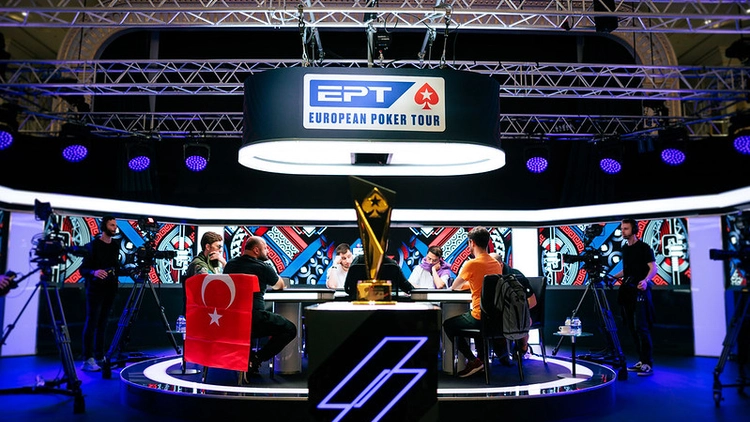
The structure changes at the final table
This is a relatively recent introduction to the EPT, but it ensures greater fairness and flexibility over play at the final table.
For similar reasons, the length of the levels are cut incrementally when the tournament reaches six, five or four players. When only three are left, levels are halved in length. And they are also halved if a deal is agreed between the remaining players.
There was once a time when EPT Main Event final tables could last all the way through the night. These measures make that an impossibility.
All in all, the EPT Main Event structure is designed specifically to optimise the enjoyment for all players, cut down on fatigue and give the maximum amount of play for everyone.
READ MORE
Back to TopLatest Articles





View Other Blogs