Playing Poker Without Initiative
Let’s face it — when we first start out in poker, it’s no fun to play the role of the defender. Calling a pre-flop raise or 3-bet and having to navigate tricky post-flop situations can feel uncomfortable fast. We call these situations playing ‘without the initiative’. Online poker today has evolved to be more aggressive and requires a lighter, more nuanced touch. Sure, the fundamentals remain the same, but a modern approach is needed. So, with this in mind, let’s cast our minds back to the basics and, before getting into some strategy, we’ll see how our tools are coming along.
What is Initiative?
We talk about initiative in sports all the time and for good reason. A football team is said to have the initiative when it is pressing hard for a goal and the other team is defending. In boxing, the fighter who is doing the attacking is said to have the initiative. In poker, it’s the same: the pre-flop raiser is the one pressing; attacking; trying to win the pot, while the pre-flop caller has defended his blind (or maybe his button). On the flop it is customary for the weaker, capped range to check to the stronger uncapped range. This is because the opener normally has a stronger range. He entered the pot voluntarily without having posted a big blind. The BB caller, on the other hand, was priced in to see a flop and defend his blind with a lot of different hands. For this reason, the BB is in a defensive position as far as range vs. range goes. Therefore, he can be said to lack the initiative.
Modern players, while still aware of this important concept, look to range dynamics and texture-specific exceptions. As an example, on certain flops BB can take the lead. But, as fundamental, the pre-flop raiser brings the initiative.
Initiative, at its most basic, simply reflects positional advantage and is a reflection of range strength.
Procedural Checking
It’s not initiative that will make us check to the pre-flop raiser, it’s because his range outperforms ours on the majority of flops. His range outperforms ours on most board textures. With the bulk of our range, we did not defend our blind because we expected to win money, but because we sought to reduce our losses. Optimal big blind play is all about doing exactly that and no one wins from this position on the table in the long run – literally no one – in any game – ever.
This approach still holds true today – though certain population tendencies have evolved. The BB is afforded more opportunity to go on the counterattack as opposed to having to check or fold because players c-bet smaller and also less frequently in 2025.
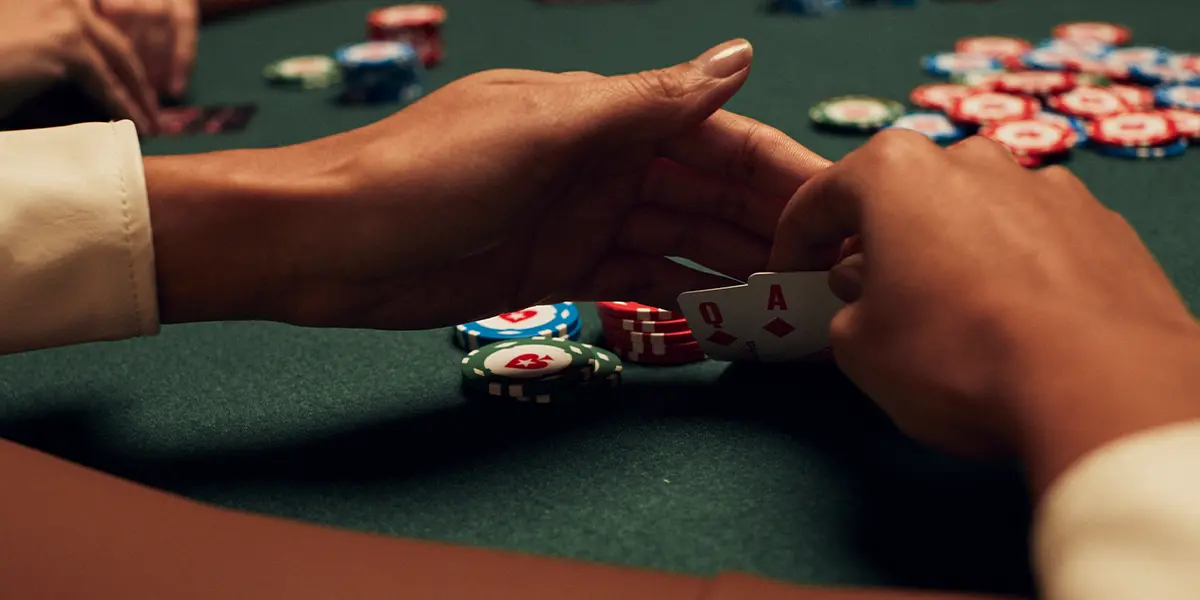
Checking to the raiser is the norm because we do not wish to build the pot, all things being equal, with our average hand against our opponent’s average hand. Of course, we might have a particularly strong hand, but even then, we do not wish to build the pot in the manner of leading out. The problem is obvious. If we donk-lead our good hands and check our bad ones, we telegraph our hand strength to our opponent and allow him to destroy us in the long-term. In my book The Grinder’s Manual I call this automatic check the ‘procedural check’. It is literally a matter of habit unless we have information to the contrary.
Donking
Unless you’ve flatted an unusually strong range from the BB, it’s generally suboptimal to donk-bet often on the flop. However, we can elect to donk-bet for exploitative purposes. Against passive players who do not bluff raise, a cheap donk-bet can be a great way of simply winning the pot when both players have bricked the flop. The best board textures on which to make this play vs. the right sort of placid opponent are wetter, lower ones. On these boards, our decent hands are vulnerable and do not at all mind if Villain folds a worse hand with two overcards to our pair. Moreover, much of Villain’s range will be unpaired at this point and on a flop like 8♦7♦3♥, an unimaginative timid player will have a very hard time defending often enough to a 66% pot sized donk-bet.
In today’s softer games, donk-betting has actually made a bit of a comeback, especially at micro and small stakes, where players still overfold to unexpected aggression.
Floating
Importantly, there is still the opportunity to fight back when checking without the initiative – which is a regular situation. When Villain makes a one third pot c-bet, as is quite popular in today’s games, we only need to be winning the pot 20% of the time to break even on a call. This is because we are risking just one unit to win the pot (three units) plus Villain’s bet (one unit). We are getting 4:1 or 80:20 on our money. It follows from this that the requirements for calling a flop c-bet are very low.
On textures where the in-position player’s range appears weaker than it looks, today’s players look to float more aggressively. An expertly timed float followed by turn aggression is now a vital part of most post-flop strategies.
When Villain bets one third of the pot in position on J♠8♠4♦ and we hold 9♥7♥, our prospects are poor, but for us to fold, they would have to be terrible. We should call here and expect to be entitled to one fifth of the resulting pot due to a few factors.
First off, we have a draw to a very strong hand and might make more money if we get there. Secondly, Villain will give up sometimes on the turn, allowing us to bet and win on the river. Thirdly, we might just hit one pair and that might turn out to be good enough. Yes, we are usually going to lose here. Yes, you don’t need to feel happy about it. But no, you certainly don’t want to fold quite yet.

Raising
A move with real power is the check-raise and it always allows a player to fight back and reclaim the initiative. The most normal way to use the raise button in these cases is to use a polarised strategy, meaning that you will attack the in-position player’s c-bets with a mix of very powerful made hands and some of the more attractive semi-bluffs. For example, on a flop of J♣J♦2♣, we might raise 4x the c-bet with a mixture of 22, strong Jx, some flush draws, and a few backdoor diamond draw hands such as Q♦10♦.
Frequency and sizing have become much more nuanced in modern online poker with the desire to punish aggressive c-bettors with smaller raises on certain textures.
This applies a lot of pressure to our opponent and puts many hands in a difficult spot. At the same time, we avoid the trap of raising mediocre hands that are only likely to get action when they are beat and will almost always get action if they are second best.
Summary:
- Basically, Initiative = positional advantage + range strength — all still vital modern concepts.
- Lower c-bet frequencies mean adapting procedural checking as required.
- On certain flops, Donk-betting has made a return as a tool to exploit.
- If the price is right, floating small c-bets can be a profitable option.
- Taking back initiative can still succeed with check-raising.
- ‘Without initiative’ in modern online poker means understanding when to defend, when to attack, and how to exploit modern population habits.





View Other Blogs