
How to Calculate Outs
An easy calculation you should learn, even in the early stages of your poker career, is the concept of counting “outs”.
Outs are the cards you could hit to improve your hand on future streets, potentially making the winning hand.
Knowing how many outs you have is the first stage to understanding your poker odds when you have a drawing hand. You can then use this knowledge to make well informed decisions when it comes to calling to see the next card.
What Are Outs in Poker?
Poker outs are any cards still left in the deck that can improve your hand on future streets.
The relative strength of a poker hand can increase or decrease on the flop, turn and river. If you have a hand that is likely losing, but has the potential to improve, you’ll need to decide whether it’s worth continuing if faced with a bet.
To make this decision, you need to identify which cards will improve your hand so you win at showdown. These are your outs.
A common example of this is a flush draw on the flop. Let’s say you have four hearts in your hand between your hole cards and the board card. Your outs are any heart cards that will complete your flush.
Later on, we’ll go through major drawing hands and discuss the number of outs for each. We’ll also show you how to use your number of outs to make better informed decisions with draws.

How to Count Outs Step-by-Step
To calculate your number of outs in poker, follow these steps:
- Identify your hand – Look at your hole cards and the board cards to see if you have any potential draws. What ways can your hand improve that will make it likely you can win the pot at showdown?
- Count your outs – Work out which cards will improve your hand, then count exactly how many are in the deck.
- Subtract visible cards – Once you have seen your hole cards and the flop, you already know five cards. There are only 47 unseen cards left in the deck. Subtract any seen cards from your number of outs.
As you can see, it’s very easy to count your outs. The only potentially confusing step is subtracting visible cards. This will become much clearer once we look at the examples given below.
Common Drawing Scenarios and Their Outs
Here, we’ll run through a few examples of common drawing hands and how to calculate outs for each.
Flush Draw Outs
- You have Q♥3♥ and the flop is 7♥9♣K♥. You have a flush draw.
- There are 13 cards of each suit in the deck. You hold two hearts and another two are on the board. So four of the thirteen hearts have been dealt.
- This means that there are still nine hearts that could come. They are A♥J♥10♥9♥8♥6♥5♥4♥2♥. That’s nine cards that can improve your hand to a (probable) winner.
- With a flush draw, you have nine outs.
Open-Ended Straight Draw Outs
- You have J♠10♠ and the flop is 6♣Q♥K♦.
- Any ace or nine will complete your straight. This is known as an “open-ended” straight draw.
- There are four aces A♣A♦A♥A♠ and four nines 9♣9♦9♥9♠ in the deck.
- With an open-ended straight draw, you have eight outs.
Gutshot Straight Draw Outs
- You have J♥9♠ and the flop is K♣Q♥7♦.
- Only a ten in the middle would make your straight here. This is referred to as a “gutshot” straight draw.
- There are four unseen cards you can hit 10♠10♣10♥10♦.
- With a gutshot straight draw, you have four outs.
Straight Draw With Two Overcards
- You have K♥Q♥ and the flop is J♠10♦2♣.
- Any of the four aces or four nines will give you a straight, A♣A♦A♠A♥, 9♣9♦9♠9♥.
- If your opponent has a pair on the board or lower pocket pair, pairing your king or queen will also give you the winning hand. Subtracting your own K♥ and Q♥, you have three kings and three queens left in the deck that are outs, K♣K♦K♠Q♣Q♦Q♠.
- Adding together the eight outs for the straight and six outs to hit an overcard, you have 14 outs.
Straight Draw AND a Flush Draw
- You hold 6♥7♥.
- The flop is 4♥5♣J♥.
- You have both an open-ended straight draw and a flush draw.
- As you will recall from the earlier example, this gives you nine cards to make the flush (A♥K♥Q♥10♥9♥8♥5♥3♥2♥). But the eight cards you’d need to make a straight are reduced to six (8♣8♦8♠3♣3♦3♠) because the 8♥ and 3♥ have been counted for your flush draw’s outs.
- You have fifteen outs.
Improving a Set Outs
- You hold 7♦7♥. The board shows 2♠7♠J♠. You have a set – which is generally strong – but you can already be behind to an opponent holding two spades.
- You can still improve to beat a flush. To do this you need to “pair the board” with another jack or two to make a full house. Or even the final seven to make four-of-a-kind.
- The cards that could improve your hand by pairing the board are J♥J♣J♦2♣2♦2♥7♣.
- You have seven outs. You will also pick up three more outs if your hand doesn’t hit on the turn. For example, if the turn is a four, you then have three more fours to hit and make a full house.
Counting Outs Accurately
As you can see from the examples above, counting outs is not too difficult. You can also study those examples to learn each of the common scenarios.
As an aspiring poker player, it’s useful to learn how to count outs on your own. When counting outs, always be mindful of the following:
Don’t Count the Same Card Twice
Some cards might complete more than one draw. For example, if you have a flush draw and straight draw, two of your straight draw outs will also complete your flush. Be careful to only count outs once.
Dirty Outs
Some outs might improve your hand but also help your opponent. For example, if your opponent has a flush draw and one of their outs completes your straight, then this is a dirty out. You can’t always tell what dirty outs are. But if there’s a possibility one completes your opponent’s hand you should be aware of it in your calculations.
How to Convert Poker Outs to Poker Odds
Calculating outs is useful in telling you how many cards you can hit to improve. But its true purpose comes to light when we start converting poker outs into poker odds. Thankfully, there’s an easy way to do this by using the Rule of 4 and 2.
Rule of 4 and 2 in Poker
The Rule of 4 and 2 is a simple way of calculating equity of a drawing hand based on the number of outs that you have. All you need to do is multiply your number of outs by 4 on the flop or 2 on the turn. This will give you a rough equity sum.
Here’s a flush example:
- You have a flush draw on the flop, giving you nine outs. You multiply this by four, which gives you 36 percent equity with your flush draw.
- You have a flush draw on the turn, giving you nine outs. You multiply this by two, which gives you 18 percent equity with your flush draw on the turn.
This is not a 100 percent accurate calculation as it assumes that there are 50 unseen cards left in the deck, when in fact there are fewer. But it’s fit for purpose as an approximation of equity.
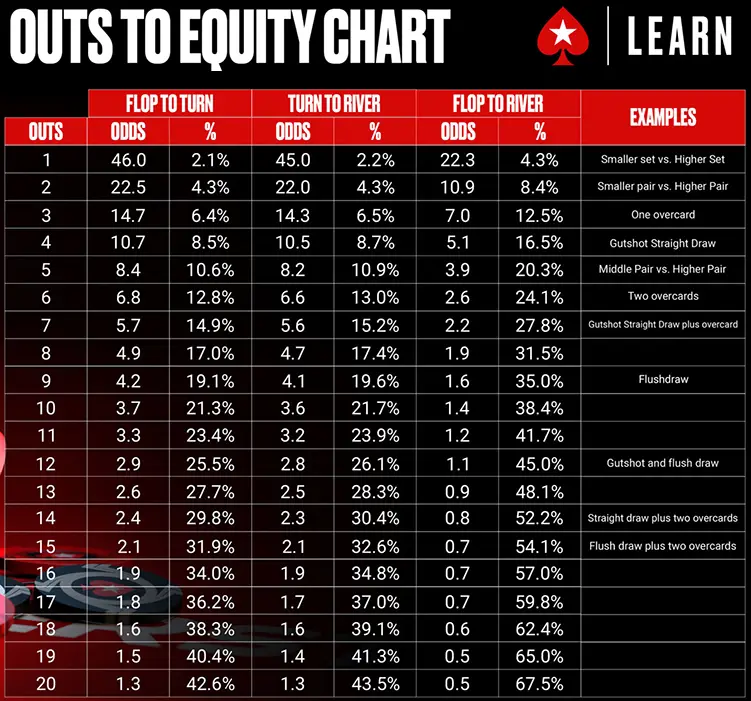
Poker Outs to Equity Chart
There are many combinations of draws and overcards in poker. The chart below gives you an even quicker way to calculate your equity. It’s based on outs without using the Rule of 4 and 2 (although, again, we recommend that you learn how to do these sums on your own to advance as a poker player).
How to Use Outs to Make Better Decisions
Now that you know how to calculate your outs, and convert this into your equity with drawing hands, you’re ready to take the final step. You’re ready to make informed decisions when it comes to calling with drawing hands.
First, follow the steps above and use the Rule of 4 and 2 to convert your outs into equity. Then, you can compare your equity in the hand to the price you are getting to call, known as your pot odds.
If your equity in the hand is favorable compared to the price you are getting, you can profitably make the call with your draw.
The pot odds calculation is:
Pot Odds = Total Pot / Bet Size
For example, let’s say there’s already $100 in the pot and your opponent bets $50.
Pot Odds = $150 ($100 in the pot + $50 bet) / $50
This simplifies to 3:1 pot odds. To convert your pot odds into a percentage, divide the amount to call by the final pot size and multiply by 100. In this example: (50 / 200) × 100 = 25%, giving us pot odds of 25 percent.
With a flush draw on the flop, our equity in the hand is around 36 percent, so we can profitably make the call. With a straight draw, the equity is approximately 32 percent, making a call profitable as well.
You can learn more about how to compare pot odds to equity in our pot odds guide.
Fold Equity and Semi-Bluffing
You’ll often have a fair price to call with a strong draw on the flop given your equity and implied odds (which we’ll cover more later). By the turn, it’s unlikely you can call big bets with a draw, as your equity will drop and the price will be steeper. So, while draws on the flop are decent hands, it can be difficult to actually realize your equity when faced with multiple bets.
There is a solution. By betting or raising with your draws, you pick up some fold equity which can tip your drawing hand towards being profitable.
Fold equity is the equity you gain by forcing opponents to fold their hand. You may be behind on the flop or turn with a draw, but betting or raising can make it difficult for other players to call with one pair hands. If they fold, you deny their equity and add it to your own.
If your opponent does decide to call your semi-bluff, there’s still a chance you can complete your draw on the next street and pivot to betting for value.
The only problem comes when your opponent re-raises your bluff. This will put the decision back on you. You’ll be forced to fold your draw or pay a hefty price. So, semi-bluff wisely and target opponents who are likely to fold.
Advanced Considerations
Once you have got to grips with the basics of calculating outs, you can work with these advanced concepts to further improve your game:
- Implied odds – Implied odds is the amount that you stand to gain on future streets when you hit your hand. For example, if you have a nut flush draw, it’s likely you’ll get paid off by pairs or weaker flushes when you hit. You can call bets a little looser with great implied odds.
- Reverse implied odds – Conversely, some hands carry the risk of losing chips even if you complete your draw. For example, drawing for a flush on a paired board or having the bottom end of a straight – such as holding A♥5♣ on a 6♦7♥8♠9♣ board – can still lose to higher hands. And it’s likely opponents have higher versions of these hands. Then you have to consider the reverse implied odds of the situation. In this case, you should call a little tighter.
- Blockers – Sometimes, your hand will contain cards that block opponents from hitting their outs. For example, if you have the ace of hearts on a three heart board. In that case you make it less likely your opponent will have a made flush. Likewise, opponents can also block your outs.
- Drawing dead – Be aware that it’s sometimes possible to be drawing dead. As is the case if opponents have higher versions of flushes or straights. If this is a likely possibility, you’ll need to sway towards folding even if you have great pot odds to call.
Why Learning to Count Outs Matters
Learning to calculate your outs gives you a much firmer grasp on how poker hands can swing from one way to another as cards are revealed. By taking the next step and using concepts like equity and pot odds, you’ll be able to make well informed decisions about whether to call with a draw.
After a while, you’ll remember the basic hand combinations and their outs off by heart. For now though, it’s useful to learn the calculations we’ve talked about so that you can adapt to situations when you have a drawing hand.
