Pot Odds Explained
Pot odds is one of the most fundamental concepts in poker. It’s the mathematics that underlies basic decisions. Things such as knowing whether you have the right price to make a call, or figuring out how much you should bet.
Learning how to calculate pot odds and integrating basic math into your strategy will instantly improve your skill level.
This page takes you through the ins and outs of pot odds in poker, as well as exploring related concepts like implied odds and reverse implied odds. By the time you’ve finished reading, you’ll be making better informed decisions at the tables.
What are Pot Odds in Poker?
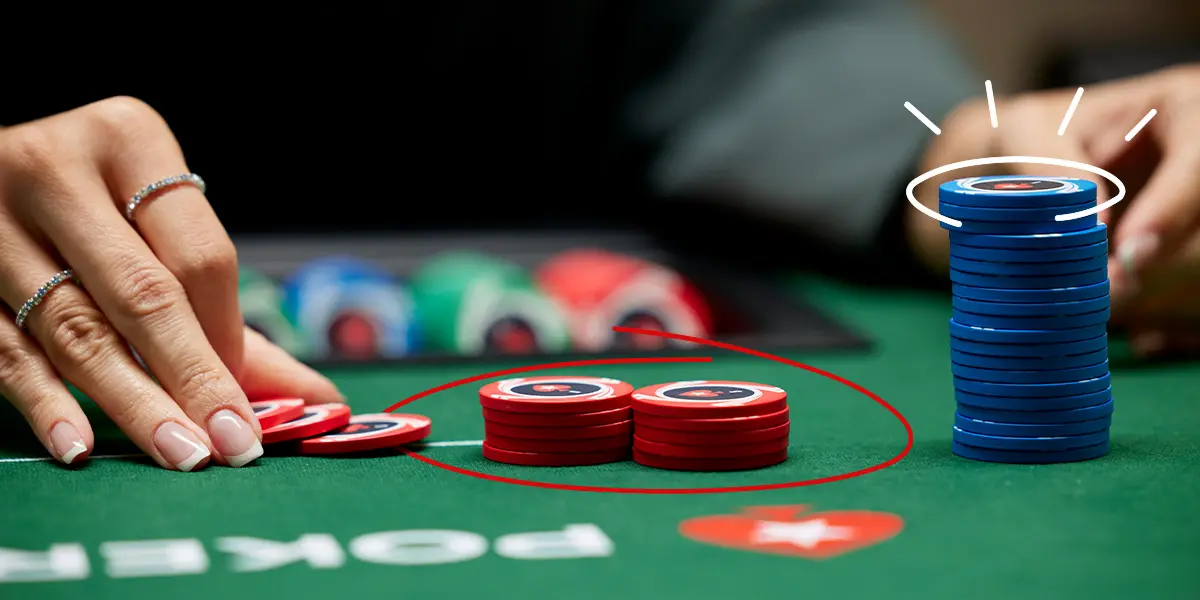
Pot odds refers to the ratio of the size of the current bet compared to the total amount in the pot.
When opponents make a bet, they will use a particular bet sizing. In no limit Hold’em, this can be anything from a single big blind to an amount over the size of the pot. The size of your opponent’s bet relative to the size of the pot determines your pot odds.
By working out pot odds, you can get a measure of how much you are risking to call a bet compared to the reward of winning the pot. You can then compare this to your chance of winning the hand, known as your equity, to see whether a call is profitable.
This may sound complicated, but it’s an easy calculation. The more difficult element is calculating your equity in the pot so that you can compare it to your pot odds. We’ll cover both of these below.
Calculating Poker Pot Odds
All that you need to calculate pot odds is a straightforward formula that compares the size of the bet to the total size of the pot.
For clarity, the Total Pot is the amount in the pot with the current bet included:
Total Pot = Current Pot + Bet
For example, the pot is 1,000 and an opponent bets 500 for a half pot size bet. The Total Pot is 1,500.
With that said, here’s the formula for pot odds in poker:
Pot Odds = Total Pot: Bet Size
So, in the example above, your pot odds are:
1500:500 = 15:5 = 3:1
Always simplify the formula down to its lowest denominator, as this will make it easier to compare to your equity later on.

Pot odds as a percentage
Once the numbers are simplified, the pot odds ratio can be converted to a percentage by adding the two numbers together and then dividing 100 by the total:
A:B
A + B = C
100/C = X%
Using our our 3:1 example:
3 + 1 = 4
100/4 = 25%
This gives us pot odds of 25 percent. It’s useful to convert pot odds to a percentage because then you can compare your odds to your chances of winning your hand, known as your equity.
Comparing Pot Odds and Equity
Pot odds are handy to know on their own, because they tell you the risk-reward of calling a bet. But, there’s another step when it comes to using pot odds in poker. To see if a call is worth making, you need to compare pot odds to your equity in the hand.
Your equity is the amount of the pot that belongs to you in the long run. Or, in terms that are easier to understand, equity is your chance of winning the pot. To make a profitable call, your equity must be greater than the pot odds you are getting.
For example:
- The pot is 50. Your opponent bets another 50, so there is now 100 in the pot.
- It is 50 to call, so you are getting pot odds of 100:50, or 2:1 to call. As a percentage, this is 33 percent.
- In terms of equity, we need at least 33 percent to stay in the pot. Given our pot odds, if we call and win the pot 33 percent of the time, we break even in the long run. If we win the pot more than 33 percent of the time, the call is profitable.
Pot Odds and Equity Guide List
Although it’s easy enough to calculate pot odds using the formula outlined above, you can also learn the numbers for some of the most common bet sizes in poker. The below chart outlines pot odds for typical bet sizes, along with the equity that you’ll need to call:
| Size of Bet | Pot Odds | Equity Needed to Call |
|---|---|---|
| Pot size bet | 2:1 | 33% |
| 3/4 pot size bet | 2.5:1 | 28.6% |
| 1/2 pot size bet | 3:1 | 25% |
| 1/3 pot size bet | 4:1 | 20% |
| 1/4 pot size bet | 5:1 | 17% |
The only difficulty is knowing how much equity you have in the hand. Often, you’ll be making an approximation based on how your hand strength compares to your opponent’s range.
In some situations, though, your equity will be clear cut, such as when calling with a draw or calling to catch a bluff on the river. We’ll explore each of these to give you clearer picture of how to use pot odds in poker.
Making Pot Odds Calls With Draws
A very common situation in poker is to face a bet when holding a flush or straight draw. At this stage in the hand, you are likely behind, as your opponent can win at showdown with any pair. But, you still have a chance to win the pot if the turn or river bring you what you need.
Players who don’t understand pot odds are left flailing in the dark when this happens. All they can do is guess, or go off a “gut-feeling”, neither of which are paths to profitable decision making.
With a flush or straight draw, you can generally assume that when you hit, you will usually have the best hand, and when you miss, you will not.
Any cards that you can hit to complete your draw and win the pot are known as your “outs”. For example, if you have a diamond flush draw, any diamond card is an out that will complete your flush.
By calculating your number of outs, you can figure out your chances of winning the pot. In other words, your equity in the pot. You can then compare this to your pot odds.
For example, with a flush draw you have nine outs, which gives you around 36 percent equity on the flop – as we’ll explain below. You can therefore compare this 36% equity to the pot odds you’re getting to determine whether a call is profitable.
Great news for anyone who struggles with math; there’s an easy way to do all this.
The Rule of 4 and 2
Here’s a fast method players use to calculate their odds of winning a hand to an approximate percentage. It’s called “The Rule of 4 and 2”.
- After the flop, count your outs and multiply by FOUR to determine the percentage of making your hand on either the turn or the river.
- After the turn, count your outs and multiply by TWO to determine the percentage of making your hand on the river.
- You can also multiply your outs by TWO on the flop when determining your chances of making your hand on the turn.
The Rule of 4 and 2 isn’t a 100 percent accurate method for calculating equity with a draw. But it’s a close approximation that is fit for purpose. You can compare this percentage to your pot odds to see if you can make the call.
Below we’ll show you exactly how to do this with a flush draw or straight draw.
Pot Odds Calls With Flush Draw
If you have a flush draw with four suited cards, you have nine outs to make your flush. There are 13 of each suit in the deck, minus four that are already showing in your hole cards or on the board.
Assuming you always win the pot when you hit and always lose when you miss, we can use the Rule of Four and Two to calculate your rough equity:
Flush draw on flop – 9 outs x 4 = 36% equity Flush draw on turn – 9 outs x 2 = 18% equity
With 36 percent equity on the flop, a flush draw can make a pot odds call against even a large bet. But, keep in mind that you may have to pay again on the turn to see the river.
With only 18% equity, you can profitably call only against a small bet – roughly around one-fifth of the final pot.
Pot Odds Calls With Straight Draws
If you have an open-ended straight draw, then you have eight outs. Four cards to complete the straight at the top end and four cards at the bottom. For example, if you have 10♣9♦ on a 7♠8♦2♦ board, you can hit any 6 or any J.
Here are the equity calculations based on the Rule of 4 and 2:
Open-ended straight draw on flop – 8 outs x 4 = 32% equity Straight draw on turn – 8 outs x 2 = 16% equity
In this case, we have less equity than a flush draw. A pot-sized bet is close to breakeven for an open-ended straight draw on the flop, so it often isn’t a great call unless you expect to realise your equity well (or win more when you hit). While even a quarter pot size bet is around breakeven for an open-ender (before implied odds).
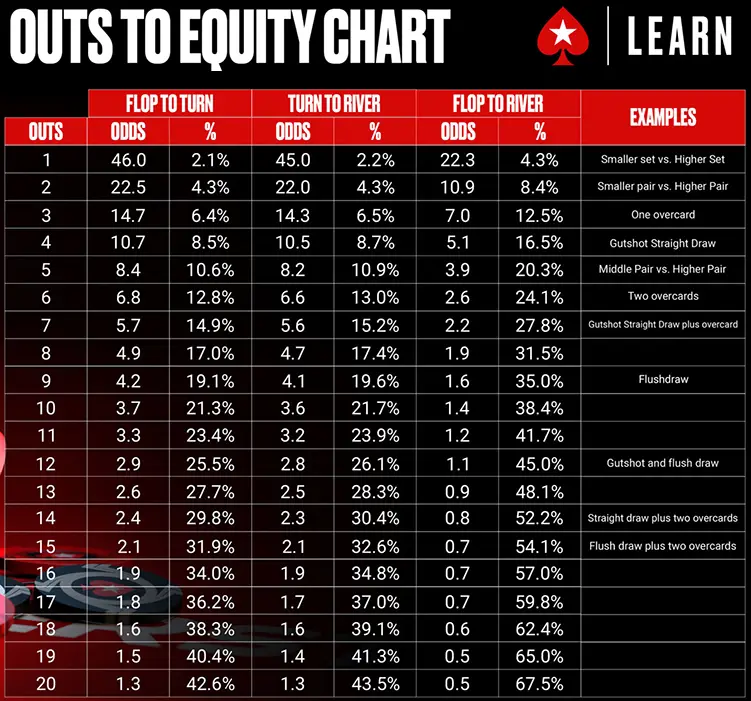
Outs to Equity Chart
The above examples of a flush draw and open-ended straight draw will serve you well for basic situations. But, many draws offer different combinations of outs. Hands such as flush draws with overcards, or straight draws with backdoor flush draws.
Here is a table of common equity calculations based on number of outs, which you can compare to your pot odds calculations to see if a call is profitable:
Implied Odds
Implied Odds refer to the amount of money or chips that we can expect to win on future streets when we improve to the best hand.
For example, when our flush draw improves to a flush. We can expect to get paid off by opponents who have top pair hands at least some of the time. If we hit a very strong flush, we may also be able to play for stacks and double up.
Implied odds are something of an estimation. We can never know for certain whether other players will continue calling or betting. You can’t assume that you will double up every time you hit. Still, it’s a useful concept.
We’ll use the example from above:
- You make the call with suited connectors and you’ve flopped a flush draw.
- The odds of making the flush on the turn are roughly 4.5:1 (4.55:1 to be precise).
- Your opponent bets and gives you 2:1 pot odds, so you’re not getting a good price to call with a flush draw.
- But, considering that there are still two more rounds of betting to come, you can expect to win more from making the call and turning the flush.
In this situation, you may be able to justify calling looser than the pot odds suggest on account of the implied odds.
Implied Odds – Factors to Consider
Although implied odds can tip the pot odds in your favor, it’s a big mistake to start calling huge bets without the right odds. When deciding how much weight to place on implied odds, consider these factors:
Stack Sizes
In order for you to have good implied odds, there needs to be enough chips to win to justify straying from the pot odds. With shallow stacks, it’s barely a factor. Both you and your opponent need to have deep stacks to take implied odds into serious consideration. That way when you do manage to stack off, you’ll have plenty to gain.
Opponent’s hand range
For your opponent to pay you off with any consistency, it helps if they have a decent hand. That way, even when you do hit your flush, they will still have a hard time folding and will feel committed to calling at least one more street of betting. The more value hands your opponent has in their range, the better your implied odds.
Player tendencies
Along with their hand strength, it’s also much easier to get paid off by opponents who have either very loose passive or very aggressive tendencies. Loose passive players will call down bets with very wide ranges. While aggressive players will bluff off chips at any opportunity. Tight players won’t offer as good implied odds, because they will fold more often when they sense danger.
Position
As with every concept in poker, position is crucial. When you’re in position with a draw, you can better control the action and are more likely to realise your equity. This increases your implied odds, since it’s easier to extract value when you complete your hand.
Reverse Implied Odds
Reverse implied odds is the opposite of implied odds. It’s the chance that you will lose a lot of chips on future streets even when you hit your hand.
A classic example of this is a pair of aces with a weak kicker. Yes, you have top pair, but your opponent is only likely to put more chips in the middle when they have a better hand. They could have you dominated with a pair of aces and stronger kicker.
The same can be true of weaker flushes or the bottom end of the straight. You can’t say that you have great implied odds in this situation, because you can’t always play for max value in case other players have you beat. When they do have you beat, you’ll likely be unable to fold.
For example:
- You bet 50 preflop with King-Jack offsuit.
- The Button 3-bets (reraises) you to 200. The price of calling is 150.
- Consider that your opponent’s typical 3-betting range will be cards which dominate your KJ. For instance, if the opponent holds AK and the flop is king-high, or the opponent holds AJ and the flop is jack-high, you’ll lose chips.
- When KJ is winning, you don’t expect to see much value from future streets. For instance, on a jack high board, opponents will fold small pocket pairs and missed broadways, which will limit the value you can gain.
- When KJ is losing, such as to AK on a king-high board, it will be difficult for you to fold the top pair hand. You’ll often be priced in to call at least two streets, even when there’s a chance you are behind.
- So, KJ is a hand which suffers from distinct Reverse Implied Odds. For similar reasons, this can also arise if you are calling to see a spade flush with one low spade, or you are on the low end of a straight-draw.
When you have reverse implied odds, this edges you in the other direction, towards folding, even when you have the right pot odds to call.
Implied odds and reverse implied odds both interact with pot odds to give you an idea of when and how much you can call. It’s based on the price you are getting right now in the current moment and the chances that you’ll win (or lose) a huge pot if you make your hand.

Using Pot Odds to Bluff Catch the River
You can also use pot odds to determine when to call with a bluff catcher. This is particularly effective on the river. With no more cards to come, your equity in the pot is based on how your hand plays against your opponent’s range.
You can also use pot odds to determine when to call with a bluff catcher.
A bluff catcher is a hand that loses to all your opponent’s value hands, but wins against all their bluff hands.
This is particularly effective on the river. With no more cards to come, your equity in the pot is based on how your hand plays against your opponent’s range.
For example, let’s say you have a pair of kings on an A-K-T-4-5 board. You are losing against any pair of aces, the Broadway straight, sets and so on. It’s unlikely your opponent will bet any hands worse than this for value.
They may choose to bet with missed flush draws or missed straights. Or complete air that they don’t want to showdown on the river and have decided to bluff. Your pair of kings beats all these hands.
So, your equity in the pot is a direct result of your opponent’s bluffing frequency. If they are bluffing 33 percent of the time, you have 33 percent equity in the hand.
Now, you can compare this to your pot odds. If your opponent bets half the pot, they give you 3:1 pot odds, so you need 25 percent equity. That means they need to be bluffing more than 25 percent of the time for you to call.
Again, figuring out your opponent’s bluffing frequency requires hand reading skills. Also an approximation of your opponent’s range so you can decide how often they are betting for value compared to bluffing. This should be based on:
- Bet sizing – Large bets often polarize your opponent’s range to very nutted hands and complete bluffs.
- Board texture – Does the board texture favour your opponent’s range? What hands could they have by the river that are worth value betting? What hands could they have missed that they are now bluffing with?
- Betting line – The action so far will provide major clues about your opponent’s hand strength. By the river, you should already have narrowed down their range.
- Player tendencies – Some players will rarely fire a river bluff even if they miss. Others will nearly always bluff rather than showdown a losing hand. How often you call will depend on how often they bluff.
Example of bluff catcher
You have a pair of jacks on a board of J♥K♥2♠4♣2♣. Given the action so far, you believe you are behind any of your opponent’s value hands on the river.
Your opponent is aggressive and made a continuation bet on the flop before checking back the turn. You checked the river and they fired out a bet of three-quarters of the pot, giving you pot odds of 2.5:1.
Converted to a percentage, giving you pot odds of 28.6%., so you need at least 28.6% equity to make the call. As you have a bluff catcher, this means your opponent needs to be bluffing 28.6% of the time or more for you to call.
You decide that they are bluffing a higher percentage of the time, given their tendencies, the board and their action so far. They checked back the turn, which they wouldn’t do often with strong pairs of kings or sets. There are enough missed flush draws and ace-high hands in their range that you can make the call.
Sizing Your Bets With Pot Odds
So far, we’ve been discussing pot odds as a way of knowing when and how much to call. But pot odds are also useful when it comes to sizing your own bets.
Think about it the other way around. If your opponents have a draw, they should be thinking about whether they have the right pot odds to call your bets. So, when you size your bets, you should do so in a way that makes them pay over the odds to continue.
For example, let’s say that you have top pair on a flush draw board. If your opponent has the draw, they have an 18 percent chance of hitting on the next card. You’ll also need to account for the implied odds that they have when they do hit. If you size too small, you’ll be giving them the right price.
If you can get your opponent to call a half pot or two-thirds pot bet, they will be making a mistake and giving you chips in the long run. This is an example of an exploitative play using pot odds.
This goes for bet sizing during any hand. You can manipulate your bet sizing to price opponents out of hands. Or force them to make a mistake when they are calling. If you keep your hand ranges balanced between value hands and bluffs, you can become unexploitable. At least from a game theory perspective.

Common Poker Pot Odds Mistakes
Here are some common mistakes that players make when it comes to pot odds in poker:
- Calling with the wrong odds – The most common pot odds mistake is to call with draws or weak hands. You don’t have the right odds compared to your equity in the hand.
- Justifying calls with implied odds – Implied odds can be a vague concept. When you have great implied odds, you need a little bit less equity to call compared to your pot odds. The chance of winning a huge pot makes up for it. But this shouldn’t justify a poor call.
- Sizing bets wrong – Players who don’t use pot odds in poker tend to guess when it comes to bet sizing. Gaining a grasp of pot odds will allow you to use bet sizing in a way that forces opponents to make mistakes. And which will line your pockets with chips.
Conclusion
Calculating odds, outs and probabilities can seem difficult and time-consuming. But the basics are quite simple. And the ability to make simple pot odds calculations can help you build a very solid foundation for your game. This part of poker is worth learning, especially if you intend to progress further and improve your win rate.
Neglecting pot odds, meanwhile, is a big mistake. If you continually play draws without getting the right odds, you will lose money in the long run by calling too often and paying too much for draws. Or by folding draws in situations where the odds are favorable.
Get these basics drilled down and you’ll never be left guessing about when and how much to call.
