Best Two Player Card Games
There are a lot of card games that you can play by yourself. While that’s all well and good, two player card games are much more fun. Here are a few of our favourites, the reasons why and the basic rules of the game so that you can play them too.
Cribbage
Cribbage is one of the world’s most recognizable card games thanks to its iconic scoreboard. It’s a classic card game that dates back all the way to the 1600s, and despite some quirky rules, is easily learned nda just as easily enjoyed.
Each player gets a starting hand of six cards, from which each selects two cards that are placed face-down into a “crib” that will be revealed at the end of the first hand. Each player plays in turn and you must keep a running total of what the combined hand value is until you can’t play more cards without going over a total of 31, at which point the count begins again. After both players have played their hands, a cut card (random selection) is added, and each player scores points for similar combinations. One player will also earn the points in the crib. The aim of the game is to be the first player to score 121.
Scoring
Scoring is complicated, so read carefully!
Pegging (during play)
- Fifteen: Any combo of cards that adds up to 15- 2 points.
- Pair: Playing the same rank as the last card played- 2 points.
- Three of a Kind (Pair Royal): Playing a third card of the same rank- 6 points.
- Four of a Kind (Double Pair Royal): Playing a fourth card of the same rank- 12 points.
- Run: A sequence of three or more cards of consecutive rank scores the number of cards in the run. Example: 6, 7, 8 is a run of 3, scoring 3 points.
- Go: If you play the last card in a round that is not 31- 1 point.
- 31: If you play a card that brings the total to 31- 2 points.
Scoring the hands (after play)
- Fifteens: Any combination of cards that adds up to exactly 15- 2 points.
- Runs: Three or more cards of consecutive rank scores the number of cards in the run.
- Pairs: Two cards of the same rank score 2 points, three of the same rank score 6 points, and four of the same rank score 12 points.
- Flush: All four cards in your hand are of the same suit and score 4 points, and if the starter card is of the same suit, it scores 5 points.
- His Nobs: If you have a jack of the same suit as the starter card, it scores 1 point.
Dealers Scoring (after play)
- Scores for their hand and the crib.
- Dealer Scores for any combos in the crib, including fifteens, runs, pairs, and flushes.
- Scores for any combos in the hand, including fifteens, runs, pairs, flushes and his nobs.
Strategy
Cribbage is quite unique and quirky, as card games go, and it balances its appeal in being part luck and partly about the skill of the players involved. A large part of the strategy revolves around the two cards selected for the crib and how the four cards in your hand can best be played to take advantage of your opponents’ plays and mistakes. Mini battles emerge, and the variety of point scoring combinations keeps things interesting from start to finish.
Gin Rummy
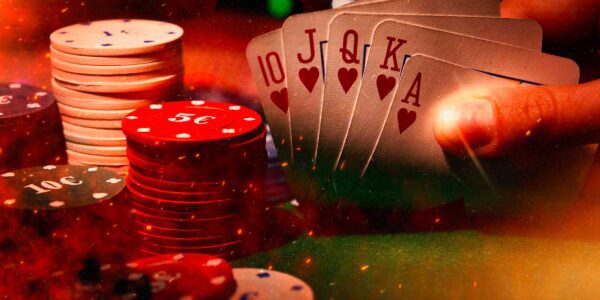
Of all the Rummy games, Gin Rummy is the undisputed king of two-player games. The process of Rummy is basically the players drawing and discarding cards, while they try to create melds that consist of sets of matching cards or of consecutive values (a run). Gin Rummy dates all the way back to the start of the twentieth century under the name Poker Gin or Gin Poker, and soon became a celebrity craze, which became incredibly popular due to celebrity influence.
Each player receives ten cards, and this is to collect sets and runs. Each player takes the top face-down card from the draw pile or the top face-up card from the discard pile. When playing Gin Rummy, players keep melds in hand until the end of the hand, which comes about when a player knocks. Players get points for full, complete sets and runs with cards worth their value and court cards worth 10. Players try to achieve a certain score over the course of the rounds.
As a two-player game, this is one of the easiest and most entertaining options. Gin Rummy can even be paused and continued at any point, which makes it so popular with busy actors and celebrities on set.
Le Truc
Le Truc is a game that dates back to the 1400s. Originally from Spain, the game was initially played with a Spanish-suited deck, which is a deck that uses coins, cups, swords, and batons. Although hard purists may argue that the game should only be played with a Spanish deck, it can be played and enjoyed with a French-suited deck just as well.
In this trick-taking game, players will bluff their way through each hand in an attempt to raise the potential score as high as possible. Every hand consists of three tricks, and the player who takes two tricks out of the three earns the points. Remove all of the cards ranked 2 – 6. The remaining cards will rank as follows: (low) 9,10,J,Q,K,A,8,7 (high).
Gameplay
The dealer shuffles and deals 3 cards to each player. One redeal per round is allowed only if both players are in agreement. Hands are discarded, and the dealer deals out three more cards.
Play moves as follows: Play begins with the non-dealer who plays one card from their hand. The dealer follows with any card. The highest card played wins the trick. Whoever takes the trick will lead the next one. If both cards are ranked the same, no one wins- this is called a spoiled trick. The player who led the spoiled trick leads the next one.
Play goes on in the same way, with each player trying to get two tricks. Before a player adds a card to the trick, they can raise the point value of the whole round by asking, “2 more?” If the opposite player accepts, the total points possible for the round rise from 1 to 2. If the request is rejected, the round ends, and the player who made the request scores points equal to the value of the prior round. Players can make more than one request per hand. Players can fold at any time during the round whether or not there was a request.
Whichever player takes 2 tricks or takes the first trick (if each player only captures one) gets points for the round. If neither player raises the value, the round is worth only 1 point. If the first two tricks are spoiled, the winner of the third trick gains the points for the round. Or f all three tricks are spoiled, no points are awarded. If a player folds during the round, the opposing player receives the points. The first player to get to 2 points or more wins the game.
Scopa
Scopa is a traditional Italian card game that is loads of fun with just two players, though the four-player partnership version (Scopone) is also a great option if you’ve got a bigger party. It is known as a “fishing” game, which means that players must match a card from their hand with one or more cards face-up on the table.
The game is played with a 40-card deck, so remove all the court cards from the deck before play starts. The cards numbered Ace through 10 are worth their face values. The dealer will place four cards face-up in a central pool, and each player starts with a hand of three cards, which will be replenished from the pool. Players use the cards in their hands to “capture” cards from the pool by matching the value of a card or by choosing cards that add up to that card’s value. After each hand, players get points in 4 categories: most cards, most diamonds, most 7s, and the 7 of diamonds. You can also earn bonus points during the game if you “sweep” or SCOPA all the cards on the table, clearing the pool. The first player to 13 points wins.
This two player card game is so much fun to play and uses a mechanic that many players are unfamiliar with, which creates a departure from other trick-taking games. Capturing cards should never be done automatically; you need to be cautious not to set up your opponent for an easy sweep. Scoring a scopa is a high point, and the possibility of it keeps the game interesting. Keeping track of the cards played will also improve your decision-making.

Top Content



Trending