Slot Variance and Volatility – Choosing Games That Match Player Preferences
Slot variance, often called volatility, helps explain how an online slot is designed to play over time. It gives a general idea of how often wins can land and how large those wins tend to be.
Low-variance or low-volatility slots on platforms like PokerStars usually spread more of their return across smaller, more frequent payouts. High-variance games normally award wins less often, but the possible payouts can be larger when they appear. Medium-variance slots sit somewhere between the two.
Some players prefer regular base-game wins, while others enjoy bonus-heavy games with bigger swings. Even slots with similar RTPs can feel completely different because their payouts are spread out in different ways. Variance and volatility help explain those differences before a player starts playing.

What Does Slot Variance and Volatility Actually Mean?
Slot variance and volatility show how often wins tend to land and how large they are likely to be. A low-variance slot tends to have smaller wins more often. The balance can rise and fall more gradually, while regular payouts can make the base game feel busier.
High-variance slots normally have wider swings. Wins can appear less often, with more of the game’s payout potential coming from larger symbol combinations, multipliers or bonus features. Medium variance offers a mixture of both. These games can include regular smaller wins alongside less frequent bonus rounds or stronger payouts. The variance rating is based on how a slot is designed across a very large number of spins. A low-variance game can still have a quiet spell, while a high-variance slot can produce a larger win early.
Are Variance and Volatility the Same?
Variance and volatility are usually used in the same way in slot reviews. Both terms explain how evenly a slot tends to pay. Low-variance games usually offer smaller payouts more often, while high-variance games can have longer quiet spells followed by larger possible wins.
The words have slightly different meanings in mathematics, but that difference rarely matters when it comes to an online slot. High variance usually means the same type of gameplay as high volatility. This is why some developers use volatility while others use variance. Both ratings are there to give players an idea of the game’s pace.

Low Volatility/Variance Slots on PokerStars
Low variance slots are designed to feel steadier. Smaller wins can show up more often, so changes to the balance can feel less sudden. This suits players who prefer regular reel wins rather than waiting through longer gaps for a bonus feature or larger payout. The max wins can be lower than those in more volatile online slots, although it depends on the game. Max win and variance aren’t always directly linked. Low variance doesn’t protect the player’s balance; it just means more of the theoretical return may be spread across smaller outcomes.
Blood Suckers Megaways
Blood Suckers Megaways from Red Tiger Gaming is a low-volatility slot with a gothic vampire theme. The game offers up to 117,649 Megaways, with the reel layout changing on every spin. Winning symbols disappear, and new ones fall into the empty spaces. If another win lands, the Chain Reaction carries on. Random Wilds can appear on reels two to five, while Super Wilds can cover a full reel with a ways multiplier from x2 to x7. Wins can also come with a random x2, x3 or x5 multiplier.
Three or more Scatters trigger five Free Spins. Each one adds a coffin pick, which may reveal extra spins, Random Wilds, Super Wilds or bonus multipliers. It also features the Daily Cash Booster, Daily Jackpot and Hourly Jackpot.
Medium Volatility/Variance Slots
Medium-variance slots sit between the two ends of the scale. They can still include free spins, Wilds, multipliers and other features, while also offering more regular wins in the base game. This can suit players who want some bonus action without the sharper swings that come with very high-variance slots. Medium-variance games can still play differently. One may focus more on regular symbol wins, while another may rely more heavily on its features.
Diamond Stars Classic
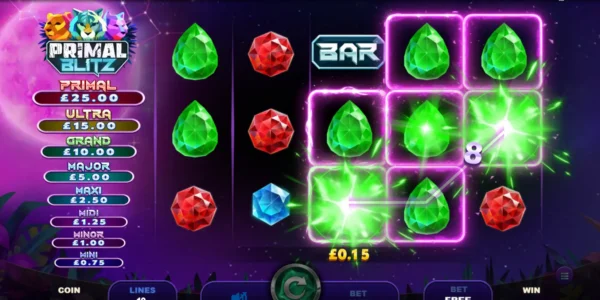
Diamond Stars Classic is a medium-volatility PokerStars Original with three reels, three rows and five fixed paylines. Its neon design mixes classic Cherries and Bars with red and blue PokerStars Spades. There are no Free Spins or separate bonus rounds. Wilds substitute for every paying symbol and show an x2, x3, x4 or x5 multiplier directly on the reel.
One Wild multiplies the line win by its displayed value. If more than one lands on the same line, the multipliers are multiplied together. An x2 and x4 Wild, for example, create an x8 multiplier. The game is played entirely on the main grid. Three Wilds pay 300 coins before any multipliers are added, while more than one Wild on the same line can increase the payout further.

High Volatility/Variance Slots
High-variance slots are built around wider swings. Wins can show up less often, and there may be longer periods where very little happens. The payouts can be larger when premium combinations, multipliers or bonus features land.
Many high-variance slots place a large part of their payout potential inside free spins, jackpot-style rounds or other features that may not appear during every session. This can make the base game feel slower, especially when the strongest mechanics are harder to trigger. Some players enjoy that tension. Others prefer the steadier pace of a low or medium variance game.
Book of Dead
Book of Dead from Play’n GO is a good example of a variance played on PokerStars. It follows explorer Rich Wilde through an Ancient Egyptian tomb filled with sandstone temples, golden scarabs and hidden treasures.
The game uses five reels, three rows and 10 fixed paylines. Rich Wilde is the highest-paying regular symbol, awarding up to 5,000x the line bet when five land across a payline. Landing three or more Book of Dead Scatters awards 10 free spins. At the start of the bonus, one regular symbol is picked at random to become the Expanding Symbol. If it lands during the feature, it can spread across the full reel without needing to sit on a normal payline. If several reels expand on the same spin, the payout can rise quickly, reaching up to 5,000x the line bet.
Related Slots Articles



Variance, RTP and the House Edge
RTP and variance explain different parts of a slot. RTP stands for Return to Player. It shows the theoretical percentage of bets that a game is designed to return across a very large number of spins. A slot with a 96% RTP has a theoretical house edge of 4%. This doesn’t mean every £100 spent will return exactly £96 to one player. The actual result of a single session can finish far above or below the RTP percentage.
Variance shows how those theoretical returns may be spread out. A low-variance and high-variance slot could both have a 96% RTP. The first may pay smaller amounts more often, while the second can pay less often but offer larger possible payouts. RTP on its own doesn’t show how quiet or busy a game may feel. The variance rating, paytable, max win and features all play a part.
Slots With the Same RTP Can Have Different Variance
Two slots can have the same RTP and still play very differently. One might pay smaller amounts regularly, while another stays quiet until a free spins round or strong multiplier lands.
The game with regular payouts may feel steadier, while the other can feel much sharper, even with the same RTP. The difference comes down to how the wins are spread out. Some slots pay more often in the base game, while others save their larger payouts for the bonus.

How Bonus Features Affect Slot Variance and Volatility
Bonus features can make a slot feel more volatile. If a lot of the game’s payout potential is tied to free spins, hold-and-win rounds, jackpots or multipliers, the base game can feel quieter because the larger payouts are more likely to come from those features.
Those bigger outcomes depend on triggering the feature and then landing the right combinations once it starts. A game with a rare bonus and powerful multipliers can have long quiet periods. When the feature triggers, the pace can change quickly.
Low-variance slots can still include bonus rounds. These can show up more often, offer lower top-end potential or make up less of the game’s overall return. A rare feature carrying most of the game’s value will normally create higher variance than a slot with more regular base-game payouts.
Does Max Win Show a Slot’s Variance?
A large max win is often linked to higher variance, but it shouldn’t be used as the only guide. Slots with maximum wins of 10,000x, 20,000x or more usually make those results extremely rare. The top payout is built into the game’s maths, which can make the results more uneven.
With that said, some games with a more modest max win can still feel sharp when there are longer gaps between wins. Others can have a large top payout while still including regular smaller features. The max win works best alongside the RTP, variance rating, paytable and bonus mechanics.
How to Find a Slot’s Volatility Rating
Some online slots show their variance or volatility clearly inside the game information or help menu. PokerStars game pages also list the rating as low, medium or high. Some developers use a numbered scale, such as one to five or one to ten.
When not stated, the game rules can give a few clues. A slot with regular smaller payouts, a modest max win and simple features may sit towards the lower end. A game with rare bonus triggers, large multipliers and a high top prize is more likely to have high variance. The paytable can also show where most of the value sits. If the regular symbols pay very little and the strongest amounts depend on one bonus round, the slot can feel sharper than a game with better base-game payouts.
How Variance Affects Budget and Session Length
Slot variance and volatility can affect how quickly a player’s balance can change from one spin to another. A lower variance slot can feel more steady because smaller wins usually land more often. A high variance slot can change more quickly, especially during a run where the stronger features don’t land. This makes betting choices and spending limits important. A high volatile title can use up the player’s balance more quickly during quiet periods, even when the maximum win or bonus features look appealing.
Players should decide on a budget before starting and avoid increasing bets in the hope of recovering losses. Changing the bet doesn’t make a feature more likely to appear. Slots should be treated as entertainment rather than a way to make quick money. Knowing the variance can help set expectations, but it cannot protect a balance or guarantee how long a session will last.
Choosing a Variance Level That Matches Player’s Pace
Variance is most useful when choosing a game that suits the kind of session a player prefers. Someone who prefers regular smaller wins may be more comfortable with a low-variance slot. A player who enjoys bonus-heavy games and does not mind quieter periods may prefer higher variance. Medium-variance slots can offer a middle ground, with some regular base-game wins and the chance of stronger feature results.
A large max win can look appealing, but it may not suit someone who dislikes waiting through long gaps between payouts. At the same time, a low-variance online slot may not suit a player looking for powerful bonus combinations. Checking the variance or volatility rating first can help players avoid choosing a slot with a very different pace from the one expected.
What Slot Variance/Volatility Cannot Do
Variance is not a playing strategy. Choosing a low-variance slot doesn’t guarantee more winning sessions. A high-variance game doesn’t become more likely to produce a large win after a quiet spell. Each spin is random. A bonus feature isn’t due just because it hasn’t triggered for a while, and a recent payout doesn’t mean the slot has to go quiet.
The variance rating also stays the same throughout play. A short run of unusual results doesn’t change the game’s underlying maths. High variance isn’t automatically better because the possible wins are larger. Those stronger outcomes are normally less frequent. Low variance isn’t safer either, as the slot still has a house edge and can produce a losing session.

Final Thoughts: Variance and Volatility Set Expectations
Slot variance and volatility show whether an online slot is designed around regular smaller wins, wider swings or a mixture of both. This can help players choose a slot that better matches their preferences and budget. It cannot predict the result of a spin, but it can explain why one game feels steady while another feels much sharper. Every spin is based on chance, regardless of the variance or volatility rating.
FAQs
What is slot Variance/Volatility?
Are slot variance and volatility the same?
What is a low-variance slot?
What is a medium-variance slot?
What is a high-variance slot?
Does high variance mean a slot has a better RTP?
Can variance show when a bonus is due?
Top Content



Trending