Heads-Up – Preflop In The Big Blind
Playing heads-up from the big blind in Spin & Gos is very tricky because you’ll always be out of position against the player on the button. This leads to a situation in which you’re basically looking to minimize losses from what is essentially a terrible position. But even though you’re fighting an uphill battle from the big blind, when you play poker with properly formulated ranges, you can still earn from your value spots and steals.
This Spin & Go Lesson focuses on playing heads-up from the big blind when faced with a button raise, limp and open shove.
Heads-up in the Big Blind “Rules”
If the button is playing correctly, they should only ever raise with a 2x big blind sizing. If you are faced with larger open-raises, then you’ll need to tighten up the ranges in this lesson considerably to adjust. If opponents are varying their sizing in a way that gives you tells, you can of course use this information to play exploitative.
When playing from the big blind, it’s crucial that you defend properly by calling with a wide range of hands. Overfolding will cost you a tonne of EV and make it nearly impossible to win heads-up matches consistently.
With the stack depths in Spin & Gos, you’ll also be looking to raise all in both for value and to exploit players who min-raise fold, especially if the button is raise-folding too often. As stacks get shallower, you’ll be looking to raise all in more frequently using hands that have blockers, such as an ace or king, as well as hands that have decent equity when called, such as suited connectors.
As stacks get really shallow, a competent opponent on the button will start to open-shove much wider. Your job in the big blind is to pick off these shoves with a well-constructed calling range.
As always in these Spin & Go lessons, don’t just stick to the range charts given here. Always adjust to your opponent as much as possible to gain even more of an edge.
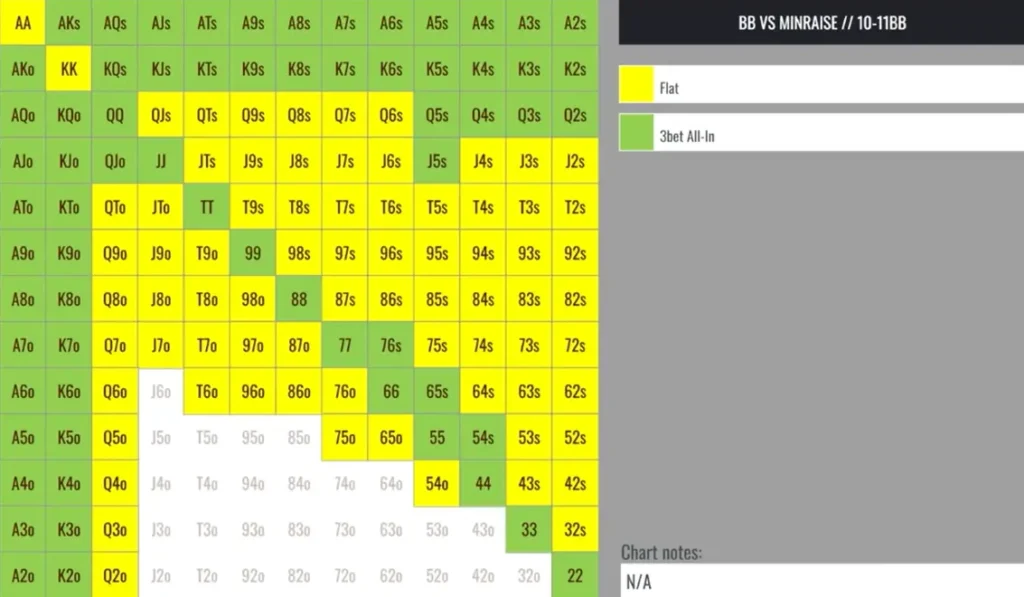
Versus Button Min-Raise 21-25BB
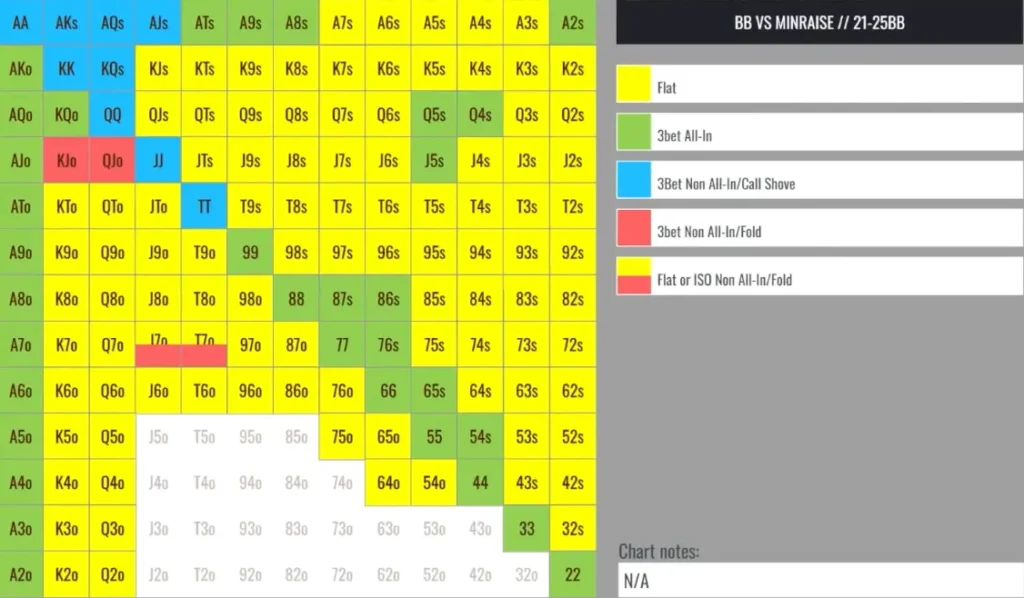
With a stack depth of 21-25 big blinds, you’ll be playing a very wide range of hands from the big blind in a Spin & Go. You can flat call with most suited hands and offsuit hands as weak as J6o and Q2o, folding out just the very weakest combos.
You can also raise all in pretty wide too. Your shoving range here includes 22-99 /A2o+ /A8s-ATs /KQo and some suited connectors that have decent equity against calling ranges. You’ll notice that hands like medium suited aces play better as a call to gain value postflop.
Three-betting not all in is reserved for premium hands like TT-AA and AJs+, along with a select few bluffs for balance.
Versus Button Min-Raise 12-14BB
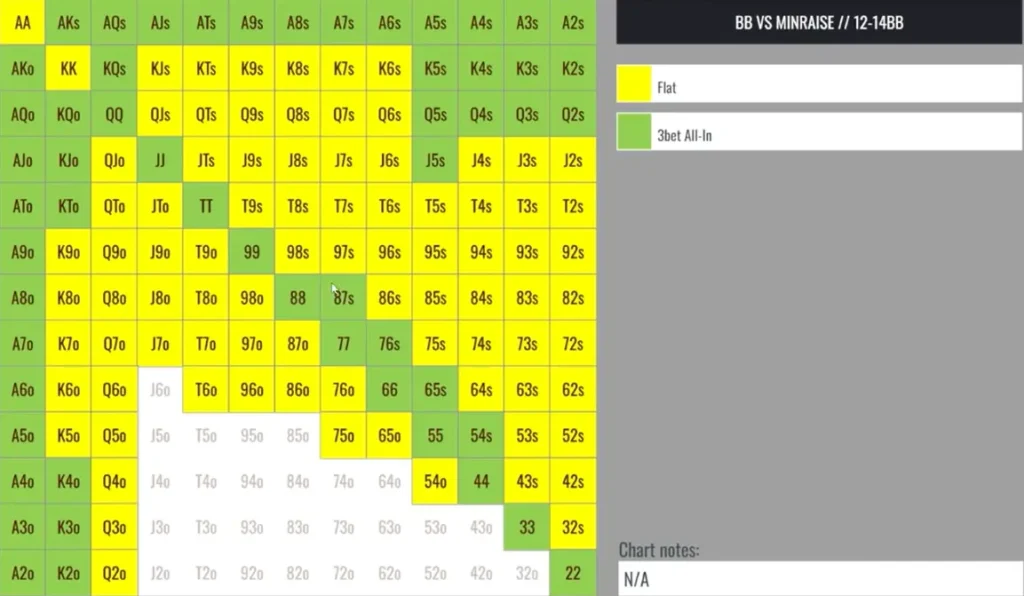
As stacks reach the 12-14bb mark, you’ll be playing a similar number of hands in the big blind versus a button raise, calling extremely wide with any suited combination and all but the weakest offsuit hands.
The main difference at this stack depth is that you have no three-bets that are not all in, only three-bet shoves. You can shove wider than before with hands that include 22-QQ/A2o+/A2s+/KTo+, as well as some low suited kings, offsuit kings and suited connectors.
The range chart recommends flatting with pocket aces and kings for value, along with some pretty strong hands that play well postflop such as K6s-KJs.
This is a range that will work very effectively by allowing you to steal against min-raises and still get paid off for your value hands.
Versus Button Min-Raise 10-11BB
With a short stack of just 10-11 big blinds, your Spin & Go big blind strategy will involve a lot more shoving. You can now profitably move all in with any ace, any king, any pair, and some suited queens and suited connectors.
You can still flat call with a very wide range of hands, although with this shallow stack depth you’ll want to fold out some of your trashier offsuit combos. You can also still trap with aces and kings by flat calling.
Versus Button Limp 20-25BB
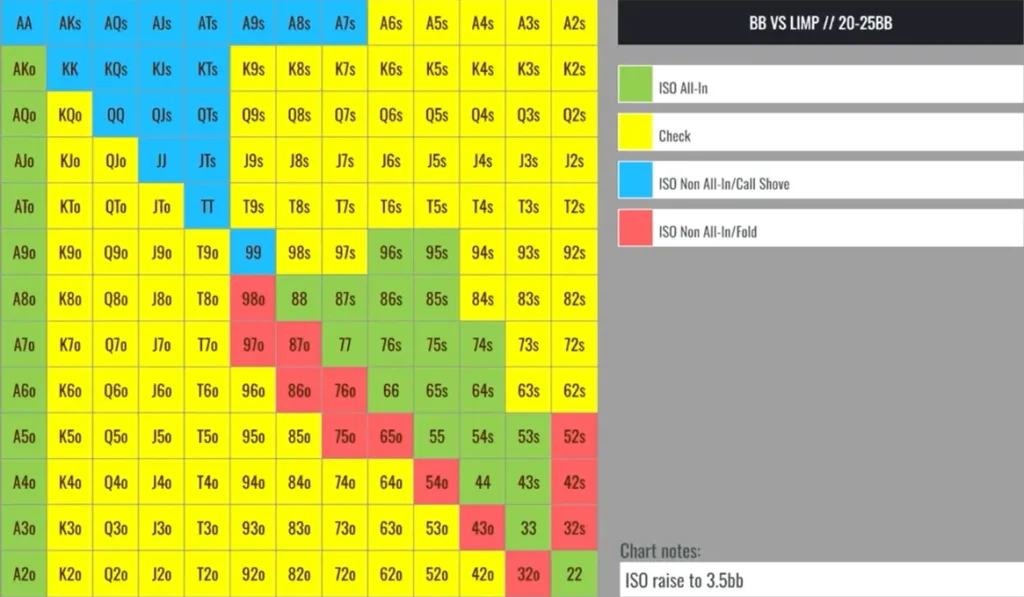
When the button limps heads-up in a Spin & Go, you’ll have the option to either check or raise. The standard raise size over a limp from out of position here is 3.5x the big blind.
The chart below shows that you’ll check most of your hands. You can shove all of your offsuit aces, small to medium pairs and some medium strength suited connectors.
When it comes to iso raising not all in, you’ll want to do this with hands that are too strong to shove like 99-AA/AJs+/KTs+ with the intention of calling a shove. This is balanced by some bluff raises that you can easily fold to a shove.
As a reminder, it’s worth pointing out that, as with all of these charts, you need to make adjustments to maximize your returns. In this case, for example, you might want to remove some shoves with weaker suited connectors and you might not always call all in to a reshove with a hand like JTs.
Versus Button Limp 12-14BB
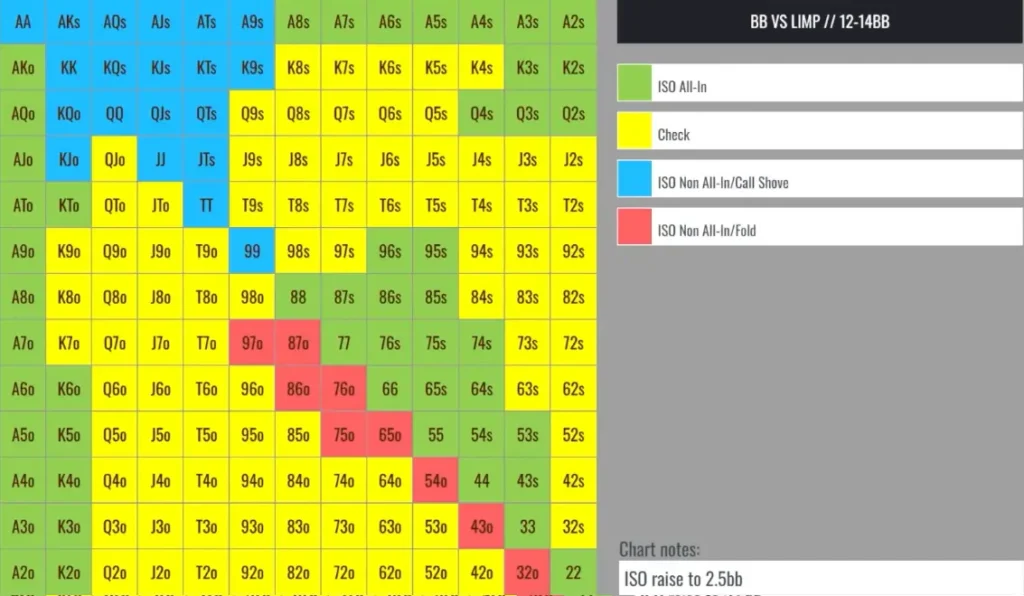
At 12 – 14BB stack depths, you’re going to have a lot more shoves versus limps. Your shoving range here includes most aces, low suited and offsuit kings, low suited queens, and some suited connectors.
You can still iso-raise not all in with hands like strong pairs, A9s+, K9s+ with the intention of calling all in, as well as raise-folding some weaker hands for balance. Your standard raise size here drops to 2.5 big blinds.
As with other stack depths, you’ll be checking back a lot of medium strength hands to play postflop.
Versus Button Limp 10-11BB
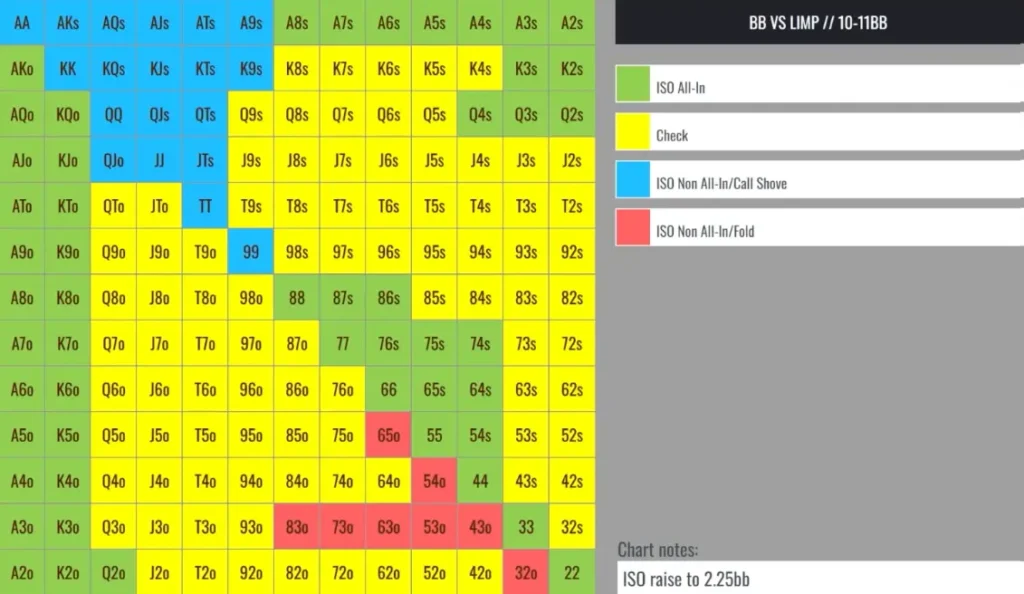
Your big blind Spin & Go strategy doesn’t change too much as stacks reach the critical 10-11 big blind mark. At this stage, you start to shove even wider over the limp with a range that now includes any offsuit king.
Big Blind Versus Button Open Shove
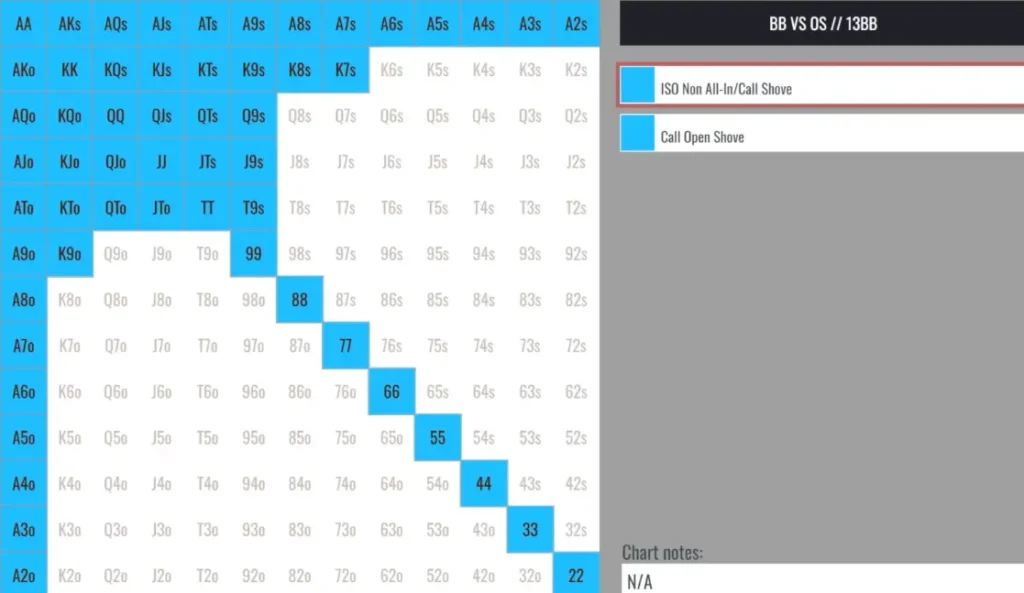
When the button open shoves and you are in the big blind in a Spin & Go, you can “almost always” call the shove with the following ranges:
- 25BB – 44+/ATo+/KQo+/QJs+
- 13BB – 22+/A2o+/K6o+/K3s+/Q9o+/Q7s+/98s+
- 10BB – 22+/A2s+/K9o+/K7s+/JTo+/J9s+
As stacks get shallower, you can call with a wider range. Below you can see the range chart for calling a button shove for 13bb effective. See the Spin & Go Lesson video for range charts for each stack size.
Of course, as always, you should adapt these ranges for other players. If your opponent shoves way tighter than they should, your calling ranges should also be tighter.
Next Lesson
By now, you should have a solid idea of GTO ranges for each position in a Spin & Go, as well as how to adapt your ranges to opponents. The next Spin & Go lesson covers Nash Equilibrium ranges for push-fold play with short stacks. It’s the final preflop lesson before we move on to postflop strategy.


View Other Blogs