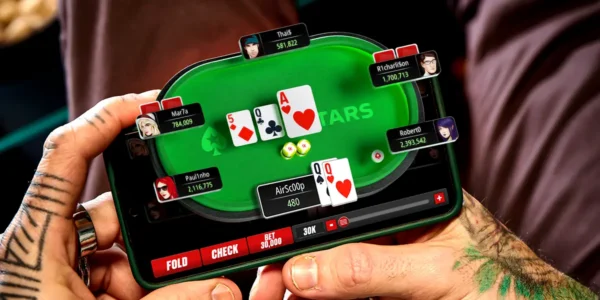
Three-Handed Preflop in the Big Blind
This lesson covers how to play poker three handed preflop from the big blind in Spin & Gos, demonstrating strategies and ranges for common scenarios such as when faced with button steals or shoves, and playing against small blind raises, shoves or limps.
The big blind is the second hardest position to play in Spin & Gos. You’ll be out of position against the button, but in position against the small blind. Ranges in the big blind are pretty standard given the stack depths, but as always you should be looking to adjust GTO charts to deal with the real opponents in front of you.
First, we’ll show you some general rules that nearly always apply and then break it down further by taking a deeper dive into ranges.
Big Blind Versus Button Raise “Rules”
When you’re sitting in the big blind faced with a raise from the button, you’re going to be calling very wide, much wider than you would from the small blind. Just how wide you should call may be shocking to some players.
There are also going to be spots where you can three-bet or three-bet all in. To give you an overall guideline, you can nearly always three bet or reshove the following hands with a 25BB effective stack size: 22-AA/AT+/KQ+.
When the button open shoves with 25BB effective stacks, you can pretty much always profitably call with 44+/ATo+/ A8s+/KQ+.
These are your baseline ranges for playing for stacks from the big blind in Spin & Gos. If you have those hands, you can move all in without too much thought. As stacks get shallower, ranges for reshoving or calling all in get wider.
With those basic “rules” outlined, let’s take a look at specific ranges for playing different stack depths from the big blind.
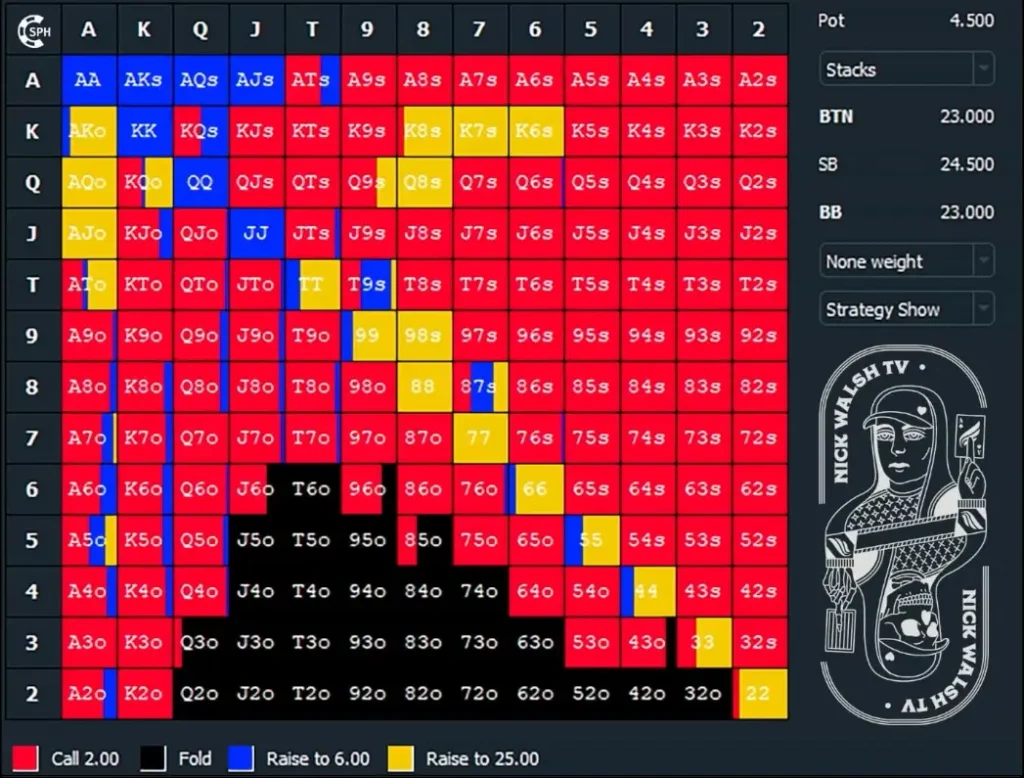
Versus Button Steal 25bb Effective
Study the GTO chart below and you’ll immediately notice just how many hands you’re defending with in the big blind against a button steal with 25BB stacks. Your calling range includes all suited hands and offsuit hands as low as T7o/Q4o/K2o. You’re only folding very weak offsuit combos.
Your reshoving range includes small to medium pairs, strong offsuit aces, along with a few suited kings and strong suited connectors for balance. You can three-bet stronger pairs such as JJ+ and strong suited aces from AJs+ with the intention of calling all in. Again, this can be balanced with a few three-bet bluffs.
It’s important to note that overfolding in this spot is very costly in terms of EV, so you should stick pretty closely to the calling range. In terms of adjustments, there’s less need to balance ranges against weak players. Simply shove or three-bet strong hands and remove the weaker portion of GTO raises.
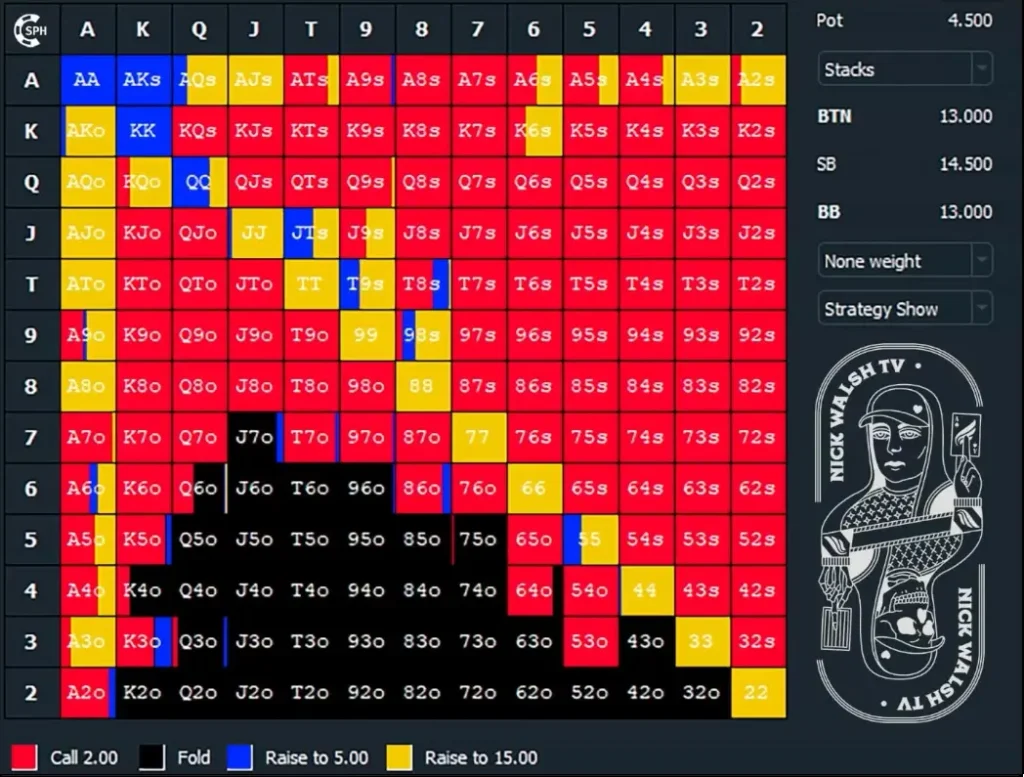
Versus Button Steal 15bb Effective
With shallower 15bb effective stacks, you’ll still be defending all of your suited hands in Spin & Gos, but now you’ll fold out some of the weaker offsuit combos that you would have called with when stacks were a bit deeper.
The main difference here is that you’re now shoving quite a bit wider. Your shoving range should now include all pairs up to pocket jacks, some small suited aces, A8o+ and some strong suited connectors.
You’re pretty much only going to three-bet with premium hands like QQ+ and AKs, along with a couple of strong suited connectors for balance.
With this stack depth, there’s not too much need to deviate from GTO ranges. Consider shoving a little wider against overfolds, or flat calling more often rather than shoving against players who are weak postflop. As always, there’s less need to balance against weaker players.
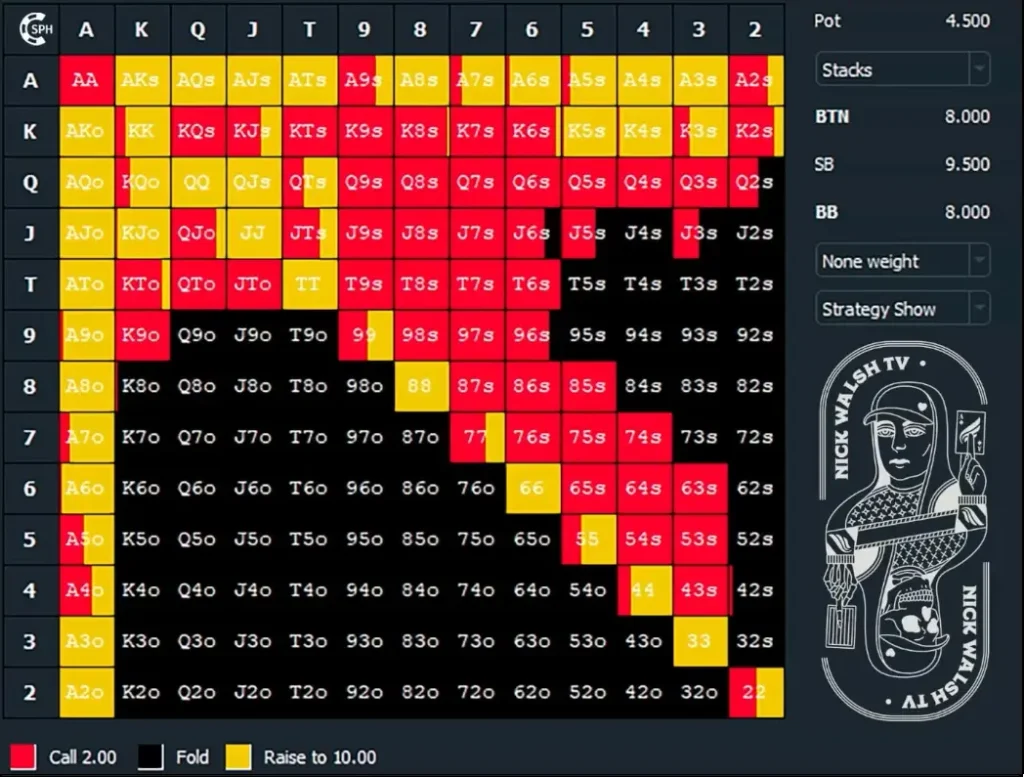
Versus Button Steal 10bb Effective
With 10bb effective in the big blind, we’re going to be calling a lot tighter, folding out a lot of those weak or medium offsuit combos that aren’t likely to connect well with the flop, as well as some of the trashier suited hands. The hands that you should call with tend to have decent equity against the button’s range.
Meanwhile, you’ll be shoving much wider with a 10bb stack. Your range should include any pair, pretty much any ace, KJ+, and some suited kings and queens.
As an adjustment, you can simplify these decisions around mixed frequencies. For example, just always shove hands like pocket nines and KQo, rather than mixing your actions. Other than that, these ranges should be straightforward.
Versus Button Open Shove
When the button open-shoves in a Spin & Go, you can use the following GTO ranges as a guideline for when to call:
- 25BB – 44+/A8s+/Ato+/KQ+
- 15BB – 33+/A4s+/A8o+/Jts+
- 10BB – 22+/A3o+/A2s+/K9s+/KTo+/QJo+/JTs+
Big Blind Versus Small Blind “Rules”
When playing in the big blind versus the small blind, you’ll always have position postflop. This means you can defend very wide against a small blind raise, especially if they are only making it 2x the big blind. You’ll see just how wide when we break down the GTO charts.
Against a small blind shove, you can usually call with 25bb effective with a range of 33+/A9o+/A6s+/KTs+/JTs+. However, you should generally call tighter against recreational or unknown players, removing hands like JTs. Again, your range for stacking off becomes wider as stacks get shallower.
When faced with a small blind limp, it’s recommended that you use different bet sizings depending on stack depths:
- 20bb – 25bb stacks – Raise 3bb
- 10 – 19bb stacks – Raise 2.5bb
- Less than 10bb – Raise 2bb
- 7bb or less – Shove or check
As always, remember to adjust your ranges and actions based on your opponent.
Versus Small Blind Raise 25bb Effective
When faced with a small blind 3x raise, which is the recommended GTO raise size, you’ll be calling very wide from the big blind with most suited hands and offsuit combinations as weak as T8o and K6o.
You can three-bet shove pairs from 22-TT, strong offsuit aces like AT and AJ, along with a select few bluffs for balance. You’ll be three-betting to around 7.5bb with premium hands like JJ+, Aqs+ and Ako with a couple of bluffs.
Interestingly, GTO ranges recommend flatting pocket aces here. This protects your flat calling range when playing against competent opponents. Against weaker players, consider raising for value. Likewise, as an adjustment, you could three-bet hands like TT for value rather than shoving.

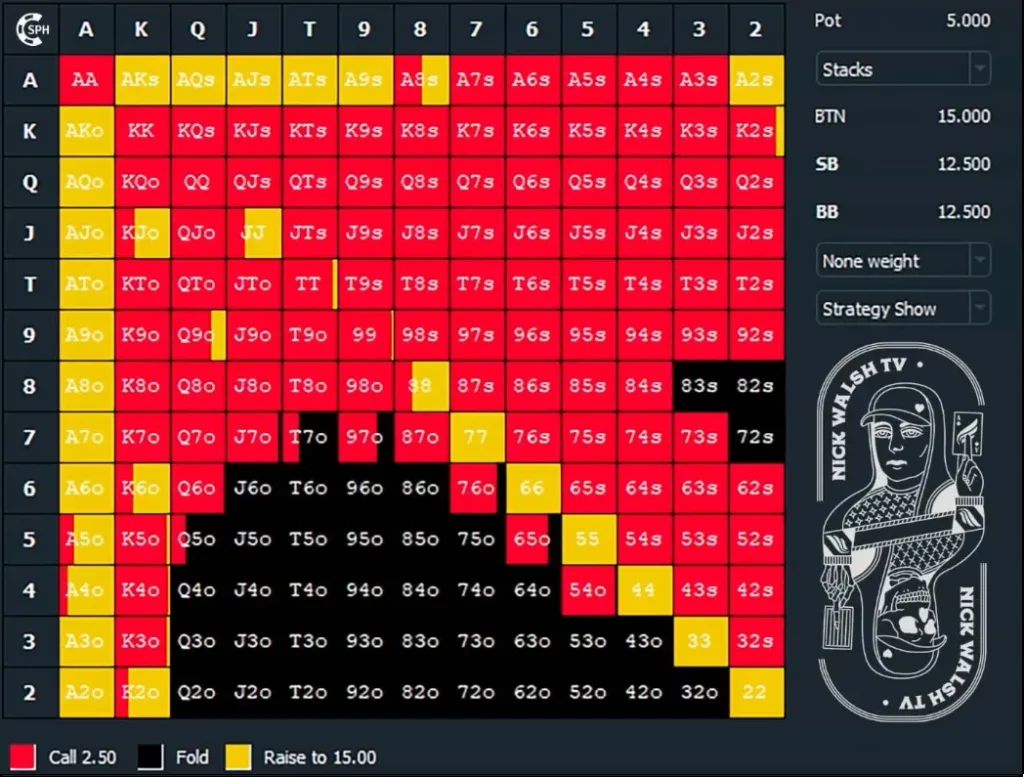
Versus Small Blind Raise 15bb Effective
When playing with 15bb effective stacks against a 2.5bb small blind raise, you’ll either be folding, calling or moving all in. There’s no incentive to three-betting not all in, as you’ll want to maximize fold equity with your bluffs and value with your strong hands.
The overall range of hands that you’ll play doesn’t change much. You’ll be calling with most of your suited hands and similar offsuit combos as with 25bb. The key difference is that you’ll be shoving much wider with a range that includes 22-88/A2o+/A9s+ and a few other hands.
Notice, however, that the GTO recommendation is to flat call with some very strong hands, including pocket aces, kings and queens. This makes for more dead money in the middle, although as an exploit you can certainly consider three-betting small with your premiums.
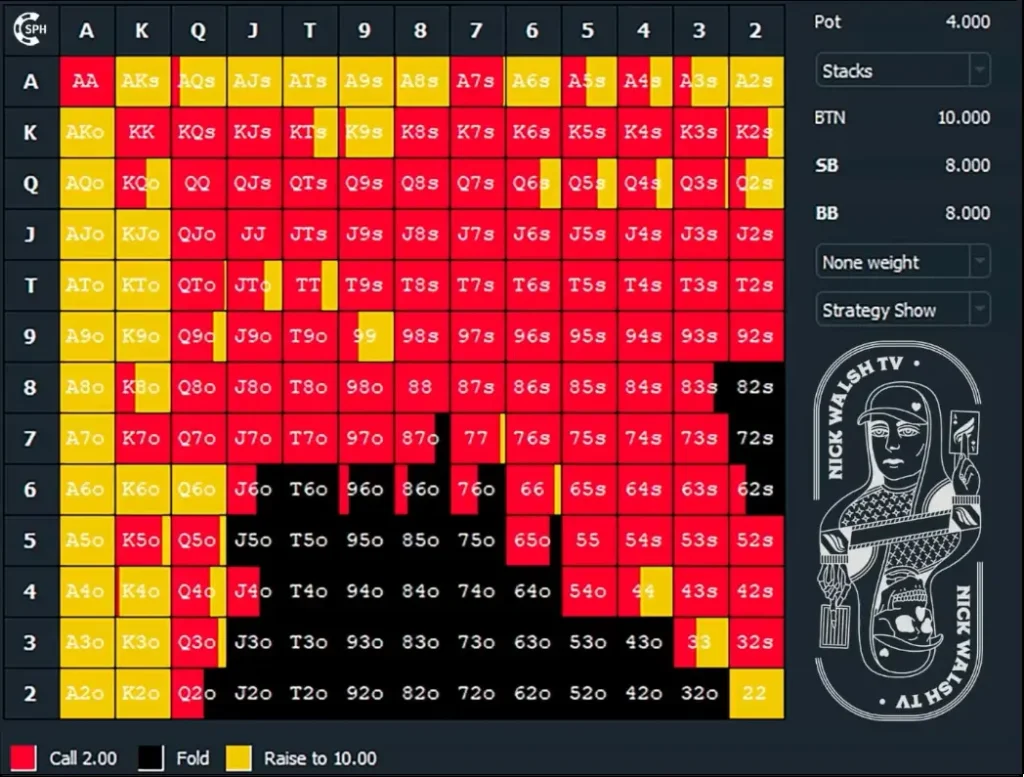
Versus Small Blind Raise 10bb Effective
The Spin & Go range for calling small blind min raises with 10bb effective stacks is very similar to with 15 big blinds, with a slightly wider calling range and a wider shoving range that includes pretty much any ace, lots of offsuit kings, and small to medium pairs.
GTO still recommends flatting a lot of your premium hands, as you’ll easily be able to get the chips in the middle postflop due to the low SPR.
One note on these ranges, most of your opponents are not min-raising as a bluff often enough, so you’ll need to adjust massively against players who either shove or fold from the small blind.
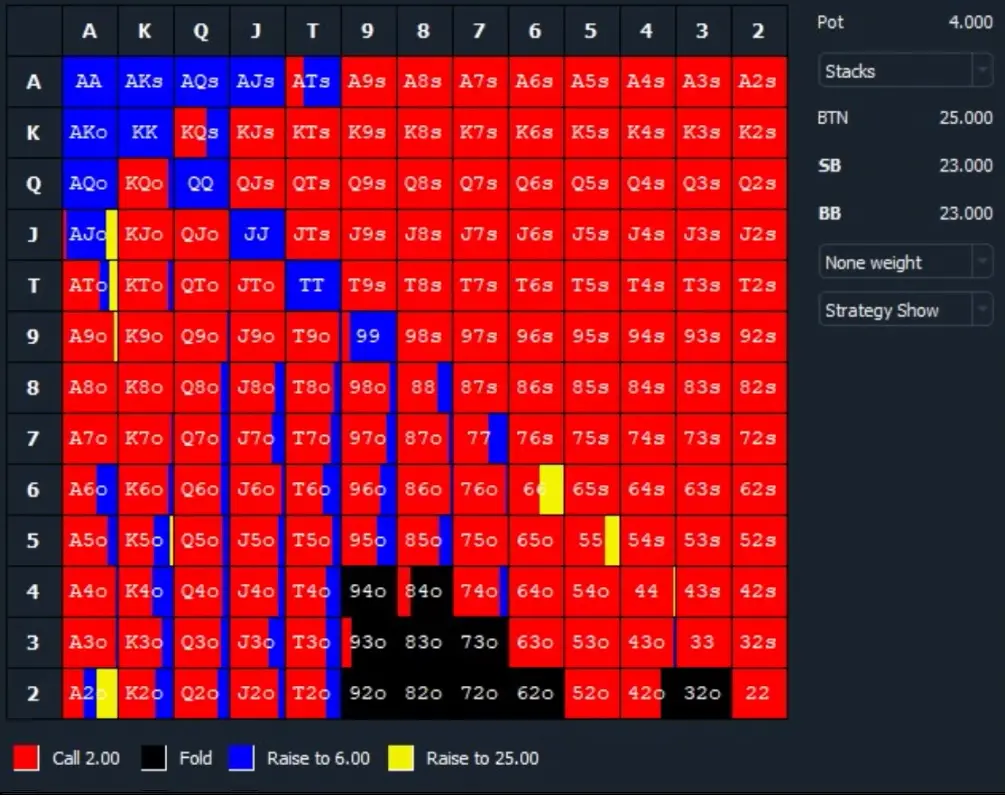
Exploiting a 2x Bet Sizing
The charts above have covered playing Spin & Gos from the big blind if the small blind is using the correct GTO raise sizing given the stacks. If they are only raising with a 2x bet sizing, even when stacks are 20-25bb deep, you can widen your range considerably to defend the big blind with almost any two cards.
In this case, your positional advantage and the generous pot odds make it profitable to call min-raises with hands as weak as T2o and 95o. Take a look at the charts below for a visual reference of how your range changes when opponents min-raise the small blind.
Versus Small Blind Open Shove
When the small blind open-shoves in a Spin & Go, you can use the following GTO ranges as a guideline for when to call in the big blind:
- 25BB – 33+/A6s+/Ato+/KTs+
- 15BB – 22+/A2s+/A4o+/J9s+
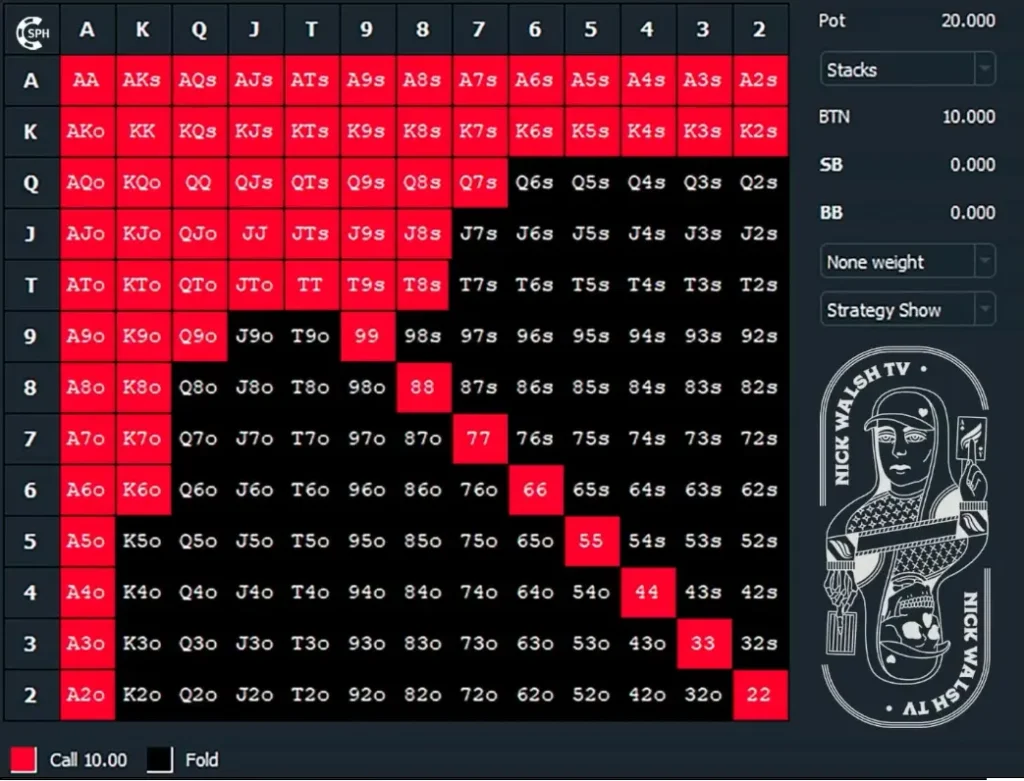
- 10BB – 22+/A2+/A2s+/K2s+/K6o+/J8s+/JTo+
Notably, you should be calling a little tighter than GTO against most players in this spot, especially at the lower stakes and particularly with deeper stacks. Below is the GTO chart for calling against a 10bb effective small blind shove:
Next Lesson…
In the next Spin & Go lesson, we’ll focus on heads-up play preflop on the button.


View Other Blogs