
Spin & Go – Postflop – A Method
Postflop play is undoubtedly complex and the game tree can sprout off in dozens of possible directions. Thankfully, it’s still possible to cover fundamentals that apply to most scenarios and to outline an overall methodology that will guide you through postflop decision making.
This Spin & Go lesson shows you how to think about postflop Spin & Go holistically and how it follows on from preflop gameplay. We’re going to be discussing conventional Spin & Go spots, sizings and scenarios, although the advice here can be applied to other forms of poker, particularly tournaments.
Preflop Dictates Postflop
The preflop action dictates postflop strategy. This cannot be emphasised enough. During the preflop stage of the hand, there’s a sequence of information that we can follow and use to start making reads.
If you were following the action, you should already be able to put your opponent on a range of hands based on their stack size, position and preflop action. For example, if your opponent raised from the button with a 15 big blind stack, you can already start to narrow down their possible hands.
A solid understanding of preflop strategy, which we’ve been covering in all of the Spin & Go lessons so far, is crucial if you’re going to compete with competent opponents postflop.
Pre to Postflop “Flow”
How do you decide on your next action? To do this, you can use the following checklist, which shows the “flow” of the hand as it moves from preflop to postflop:
- Stack depth – Before you are even dealt your cards, you can look at your own and your opponent’s stack depth. Work out the effective stacks and the mechanics of the stack depths in play for both you and your opponents. For example, with a 15 big blind stack depth, what hands will you raise, limp or shove? What hands should your opponent raise or call with?
- Preflop action – Think about the action that has happened so far preflop. Did your opponent raise? Did you raise and they call? Did someone three-bet? Or was it a limped pot?
- Define ranges – Based on stack depths and preflop actions, define your opponent’s likely range of hands. Then, define how your range is likely to be perceived by your opponent based on your own actions.
- Board texture versus range – Consider how both your opponent’s and your own range interacts with the flop. Does the flop hit more hands in your range or the other player’s? Who has the nut advantage? For example, if the flop is A-K-2, who’s range does this favour?
- Sizing versus texture and range – Next, if you are taking aggressive action, you can weigh up how to size your bets based on the board texture and how it interacts with your perceived range. Or, if you are considering calling your opponent’s bet or raise, you can think about what hands the sizing represents on this board.
- Take action – Now, only once you have carefully accounted for all of the information from preflop to the flop, you can take action. For example, you can c-bet the flop using a particular sizing.
- Repeat – You can repeat each of these steps if the hand makes it to the turn and river, considering additional actions and board cards along the way.
Postflop Hand Example 1
To further demonstrate how poker hands flow from preflop to postflop, let’s take a look at a hand example. In this hand, stack sizes are 15 big blinds effective and the villian min-raises from the button. The hero calls in the big blind. Using the six steps outlined above, how do we play the hand as it moves postflop?
- The effective stack depth is 15 big blinds.
- The preflop action consisted of a min-raise and call, the hand is heads-up.
- Preflop ranges can be outlined based on those factors by using the charts we learned in previous Spin & Go lessons.
- The flop comes A♣K♥2♦. How does this interact with the preflop ranges?
At this point, we can start to make assumptions about the hand and ask ourself how this changes our postflop strategy.
For example, study the 15bb preflop chart below for the raising player, in this case the villain. You can see they have lots of hands that hit the Ace-high board, lots of kings, some very strong hands like a set of aces or kings. Their range is uncapped, meaning they could have nutted combos and can also represent strong hands realistically when bluffing.
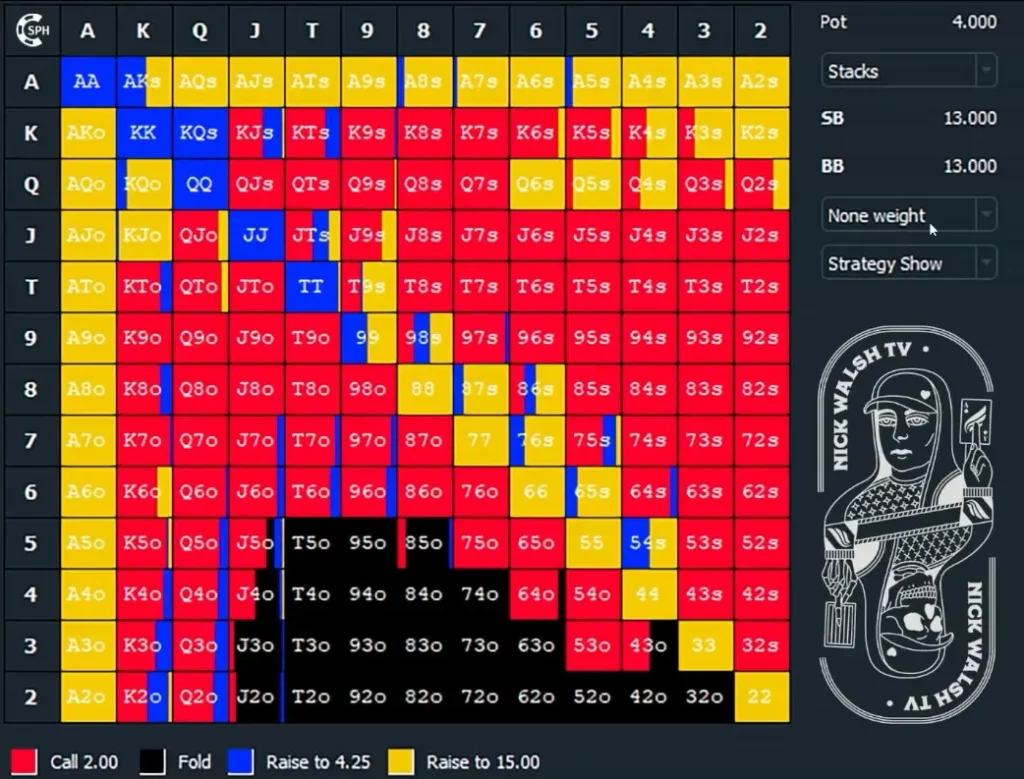
If you compare this with the caller’s range (see the Spin & Go video for more charts), you’ll see that the caller, in this case the Hero, has a lot less strong hands on this board, as they would have three-bet or shoved with lots of aces, ace-king, strong pairs like pocket aces and kings, and so on. The Hero’s range is therefore capped. They have less strong combos in their range and will also have a hard time representing strong hands when they bluff.
Now, we can move on to 5) – bet sizing based on the board texture and 6) – taking action. On this board and with our preflop calling range, it’s unlikely we will want to bet or call a bet. We will be forced to give up very frequently based on the fact that we don’t have many value hands and can’t readily bluff.
The in-position player, meanwhile, is likely to bet this flop very often as both a value bet and bluff. Because the board texture is very dry, they should use a very small bet sizing, c-betting as little as one big blind.
Dry Versus Wet Board Texture
The example above shows a dry board texture. But what is a dry or wet board texture and how does it impact your postflop approach to the hand?
- Dry texture – A dry texture is one in which community cards lack diversity in suits and rank, so that there are a limited number of possible draws or strong hands. Examples include A♦8♠3♣ and Q♥7♣4♦ . On a dry board, you should use a smaller bet sizing when taking aggressive action and attack the flop frequently for value and as a bluff. Your opponent should also be doing the same. A bet sizing of ¼ to 1/3 of the pot is effective on dry textures.
- Wet texture – A wet texture is when community cards are diverse, with lots of combinations of suits and ranks, which makes numerous draws and strong hands a possibility. Examples include J♥9♥8♦ and 7♠6♠4♠. Both you and your opponent should attack wet boards less frequently as bluffs are more readily called. However, when you do attack you should size up your bets. A bet sizing of ½ to ¾ of the pot is effective on wet boards.
Texture variation
Not all “dry” and “wet” boards are exactly the same. You can’t just make the same move on every board based on whether it’s dry or wet. For example, an A♦8♠3♣ board is very different to a 9♦8♠3♣ board. Even though both are classed as dry, they have very different characteristics and hit ranges differently.
For example, the ace-high board tends to favour the preflop aggressor’s range, which will consist of lots of Ax combinations. A nine-high board, though, hits a limp or callers range stronger, as they will still have lots of nines after capping their range.
Keep this is mind as you make your decisions, always being careful to compare the texture to actual ranges based on the other factors we outlined in the “flow” from preflop to postflop.
Postflop Example 1 on the Turn
When it comes to the turn, you should consider everything you have done so far with regards to preflop and postflop action, board texture and ranges. You can then consider how the turn card itself impacts play by asking the following questions:
- Does the turn card help my hand and range?
- How does the turn card change the strength of our opponent’s range?
- How does this change our postflop strategy?
On every betting round in Spin & Gos or any other poker format, always return to the source, starting with preflop actions and ranges. From there, follow the methodology outlined in this lesson. Repeat on every street.
See the Spin & Go video for more details on the postflop method outlined, as well as some practical examples to help you to cement the knowledge and apply it to your own game.
Postflop play is the art of narrowing a range and identifying strength and weakness so that you can size, attack or retreat against that perceived range.
Using this method it is possible, with high accuracy, to formulate postflop strategies which will make you more chips when you have value and more successfully bluff opponents when you are weak.
Next Lesson…
The next Spin & Go lesson provides you with some bonus content in the form of very practical postflop scenarios. It’s the final lesson in the series and will help you to understand postflop play in a way that you can readily apply to your poker strategy.


View Other Blogs