Spin & Go – Nash Push/Fold
By now, if you’ve been following along with our previous Spin & Go Lessons, you should have a decent idea about how ranges alter according to position and stack depth, as well as how to default to push-fold strategies in short stack situations.
Push-fold is a very common scenario in poker, especially in shallow stacked tournaments like Spin & Gos. This lesson focuses exclusively on heads-up scenarios in which the only optimal solutions are either to fold, or to go all in by shoving or calling.
This is known as Nash Equilibrium in poker. It’s a game theory concept that is applied to poker. It sounds complicated, but everything will become clearer once we look at the definition and study the charts.
What is Nash Push-Fold in Poker?
Nash Equilibrium refers to a situation in which each player makes the best possible decision, taking into account the decisions of other players, so that a balance is reached in which neither player is incentivized to deviate from their strategy. Any deviations result in you or your opponent being exploitable.
Studying Nash charts gives you an excellent baseline for poker strategy. It also leads to an understanding of how to exploit opponents based on how they deviate from GTO. If you notice inconsistencies or mistakes, you can adjust to find even more profitable betting lines.
One simple way that Nash Equilibrium is applied to poker is push-fold situations. These are situations in which moving all in or folding are the only viable options.
If our opponent is shoving Nash, we can call with the Nash range. Likewise, if they are calling Nash, we can shove with Nash ranges. If both players do this perfectly, they would break even in the long run.
Push-fold decisions are determined by mathematical calculations that take into account probabilities and potential payoffs. They are complex and usually done using computer software. Thankfully, they are easy to visually represent using charts, which we’ll look at soon.
HU Push-Fold “Rules”
Before we look at the Nash charts, here are some loose “rules” for heads-up play in push-fold situations:
- Push-fold Nash charts are best used when effective stacks are 13bb or less.
- The charts only show all in or folds, with no other betting lines.
- Nash charts are not optimal versus (most humans).
- Avoid overusing the charts and make adjustments – for example, call tighter versus unknown players.
- Use the “Double Rule” for calling.
HU Nash Push-Fold Charts
The Nash push-fold charts presented below look a bit different to the charts in our previous Spin & Go lessons, but they’re pretty easy to get your head around once you know what to look for.
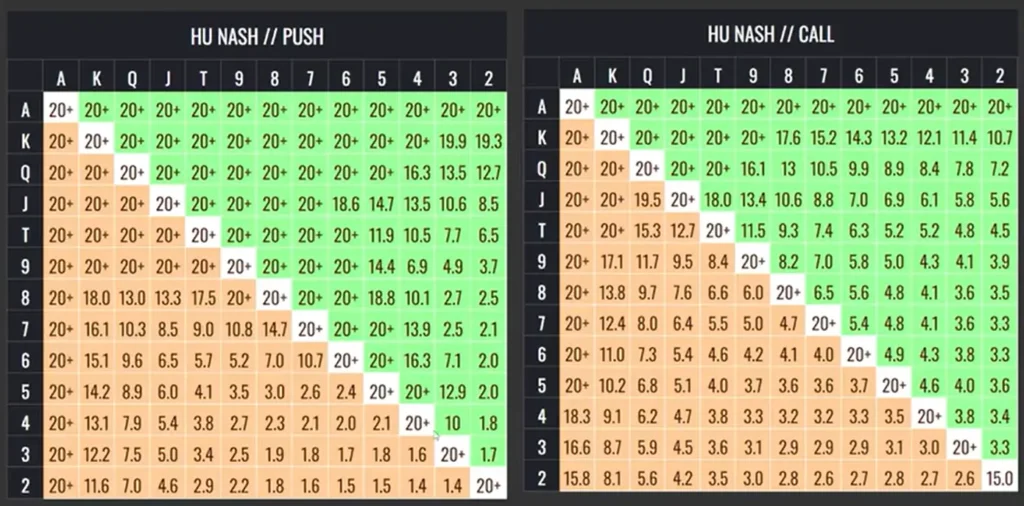
The charts represent every hand combination in poker, with offsuit combos in the bottom-left half, suited combos in the top-right half, and pocket pairs running diagonally down the middle. The numerical values show the effective stack size that you can push or call all in with given the hand – the left chart is for pushing and the right chart is for calling.
For example, if you take T-7 offsuit, you can see from the charts that the Nash solution is to shove with 9 big blinds or less and to call a shove with 5.5 big blinds or less. If you take J-8 offsuit, you can shove with 13.3 big blinds effective or less and call with 7.6 big blinds or less.
Nash Chart assumptions and adaptations
The charts above show a Nash Equilibrium for two players who are both using Nash ranges. So, for these plays to be optimal, your opponent also needs to be shoving and calling the same ranges. If they are not, you’ll need to adapt your ranges to find the new balance based on their deviations.
Rock, Paper, Scissors Example
To illustrate, consider the game Rock, Paper, Scissors. If your opponent is using a balanced, randomised strategy, they will be using a 33.3 percent split for each option. In doing so, they are playing the game perfectly from a mathematical standpoint.
In response, the perfect counter-strategy is for you to also play with a randomized 33.3 percent split. This creates a Nash Equilibrium in which both players are optimal and neither can gain an advantage by deviating and both will win an equal amount of games in the long run. This is the Rock, Paper, Scissors version of a Nash equilibrium.
But what happens if your opponent is not playing with a perfect 33.3 percent split? What if they instead favour one option over others, such as choosing Rock for 50 percent of the time? In this case, the equilibrium changes. You should now increase the frequency of Paper to counter your opponent, who is making a mistake that you can easily exploit by changing your strategy.
It’s the same in poker. Your opponents will rarely be playing a perfect strategy. The Nash charts provide an excellent baseline and a great strategy against opponents who are also playing somewhere close to Nash. Against weak or unknown players, though, it’s essential to adapt.
Adapting Your Ranges
Unless you have a read that your opponent is a reg or a GTO wizard, you should exercise caution when using Nash charts and always look for ways to exploit other player’s deviations.
When it comes to shoving, you can nearly always follow Nash charts for short stack play of 6 big blinds or less and it’s going to serve as a solid strategy all the way up to 13 big blinds. However, mixed strategies can be much more effective at the 7 – 15 big blind range.
Extra caution is required when calling all in. As has been a running theme throughout the Spin & Go lessons, GTO can be risky when it comes to reacting to your opponent’s moves. Typically, opponents will be shoving much tighter than Nash, which means you should also be calling much tighter than the charts suggest.
As a loose guideline, you can use the “Doubling Rule” when calling against tight players or unknown players. If the chart says you can call a hand with 10 big blinds, you can almost certainly call it with 5-7 big blinds even against a tight opponent.
Watch the heads-up Nash push-fold Spin & Go lesson now to learn more about the Doubling Rule and delve deeper into the charts.


View Other Blogs