Heads-Up – Preflop On The Button
In Spin & Go Lesson 6, we’re taking you through heads-up ranges preflop from the button. Heads-up is an extremely important phase of a Spin & Go because it’s where you’ll lock up most of your winnings. It’s possible to gain a huge edge heads-up, making this a crucial lesson if you’re ever going to become a consistent winner in Spins.
As with other lessons, we’re going to be looking at GTO range charts, although this time the charts are simplified to show you all actions and reactions within a single chart. This should make it easier to quickly understand and memorize combos at key stack depths.
As with any of our Spin & Go Lessons, it’s essential to think about adjusting to opponents and making exploitative plays. This is particularly important in heads-up play as there are huge deviations that can be made to gain yet more of an edge over the other player.
Heads-up on the Button “Rules”
When it comes to basic “rules” for playing heads-up on the button in Spin & Gos, you should only ever be raising with a bet sizing of 2x big blinds. This is so that you lose the minimum when you have to min-raise fold, while still accomplishing the same goal of applying pressure while in position.
Perhaps surprisingly for tournament players, there’s a lot of limping heads-up with the shallow stack depths that you’ll find in Spin & Gos. This is because we want to be able to play as many hands as possible from the button and limping allows you to have a range for limp-calling and limp-shoving.
As stacks get shallower, you can expect the big blind player to move all in with a wider range of hands as they will be incentivized to steal. Limping creates a smaller pot, allowing you to trap and continue to play medium strength hands even at shorter stack depths.
As always, you should be looking to adapt to your opponents when playing heads-up on the button in Spin & Gos. For example, against a player who never three-bet bluffs or overfolds to raises, you can min-raise much wider and limp less.
Heads-up on the Button 20-25bb Effective
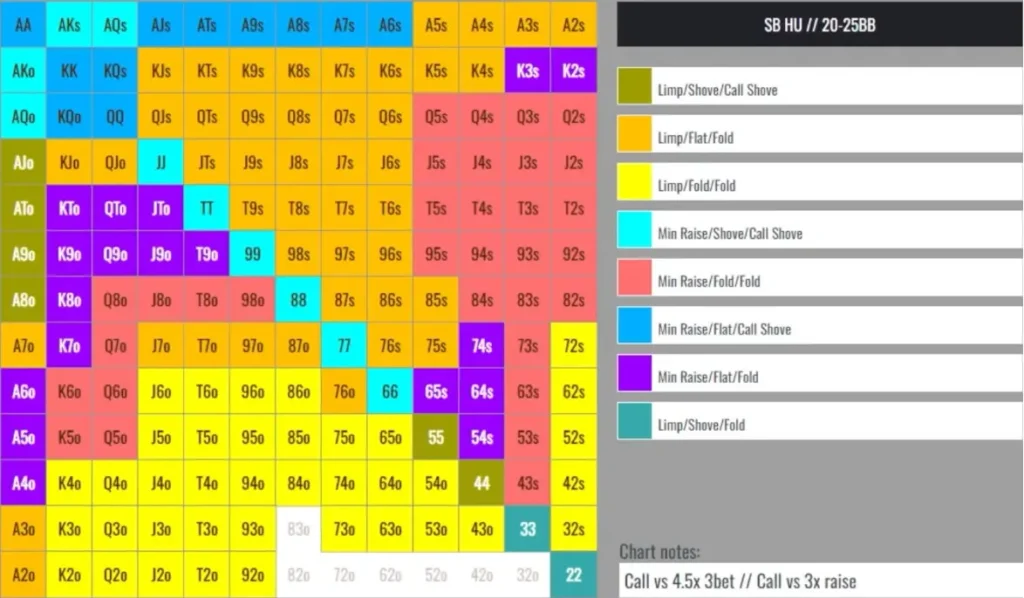
For this lesson, the GTO charts show both actions and reactions, with colour coding for each betting line. Study the chart below to get a feel for which hands you should be limp-calling, limp-folding, limp-shoving, raise-folding, raise-calling and so on.
The first point to note is that there are very few hands that you should fold heads-up from the button. You’re only folding the trashiest of trash, such as 32o up to 83o.
You’ll be limping hands as wide as 92o, which you’ll obviously fold to a raise. This will be balanced by a decent amount of limp-calls, allowing you to play a variety of high equity hands in position, as well as limp shoves with small pairs and monster hands.
Here are some common themes to look out for as you study the chart presented below:
- Small to medium pairs make excellent hands to limp shove, as you can move all in with fold equity and still have decent odds against most hands when called.
- The ranges suggest limping some medium to strong hands like A2s-A5s/KTs/JTs/Q9s and so on. This prevents you from getting raised off your hand when your opponent shoves. Instead, you can limp-call and play in position.
- You’ll be min-raise folding with a lot of weaker suited hands as steals with some playability postflop if called. You can fold these hands to a raise or shove. This is balanced by raises made with premium pairs and high suited aces, which you can readily call or shove all in with.
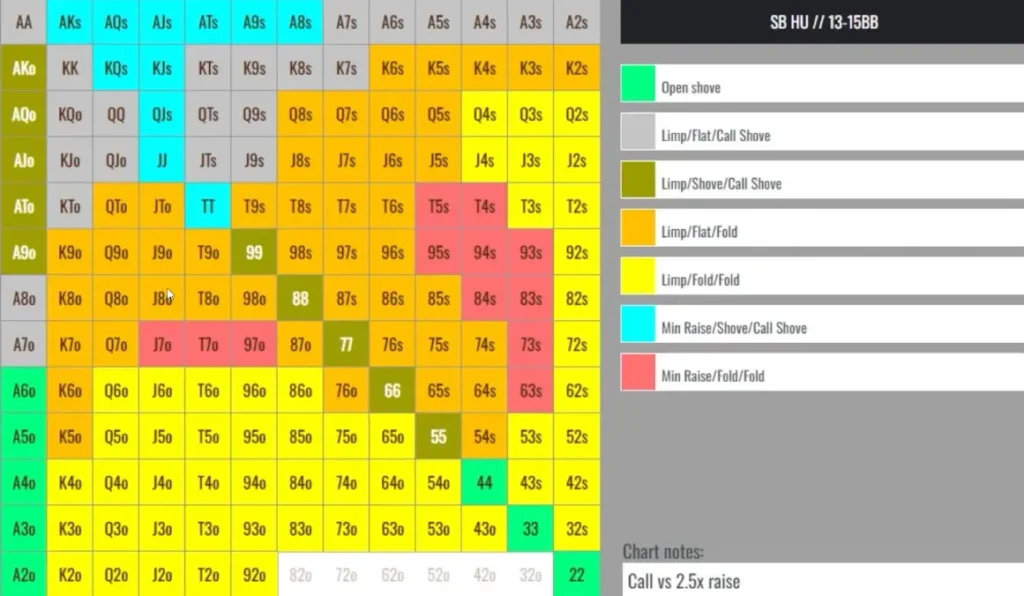
Heads-up on the Button 13-15bb Effective
With effective stacks of 13 – 15bb, we’re going to start open shoving some of those limp-shove hands from the 25bb ranges, such as smaller pairs and weak to medium offsuit aces, while limp-shoving is still very much an option with bigger offsuit aces and middling pairs.
Still, the majority of this range is made up of open-limps, with lots of limp calls so that we can still play in position with hands that have decent equity. You’ll also still limp premium pairs to trap.
You can also still min-raise fold some medium suited combos to steal, balanced by min-raising hands like TT, JJ, KJs, A8s+ with the intention of playing for stacks. Check out the chart below.
Heads-up on the Button 10bb Effective
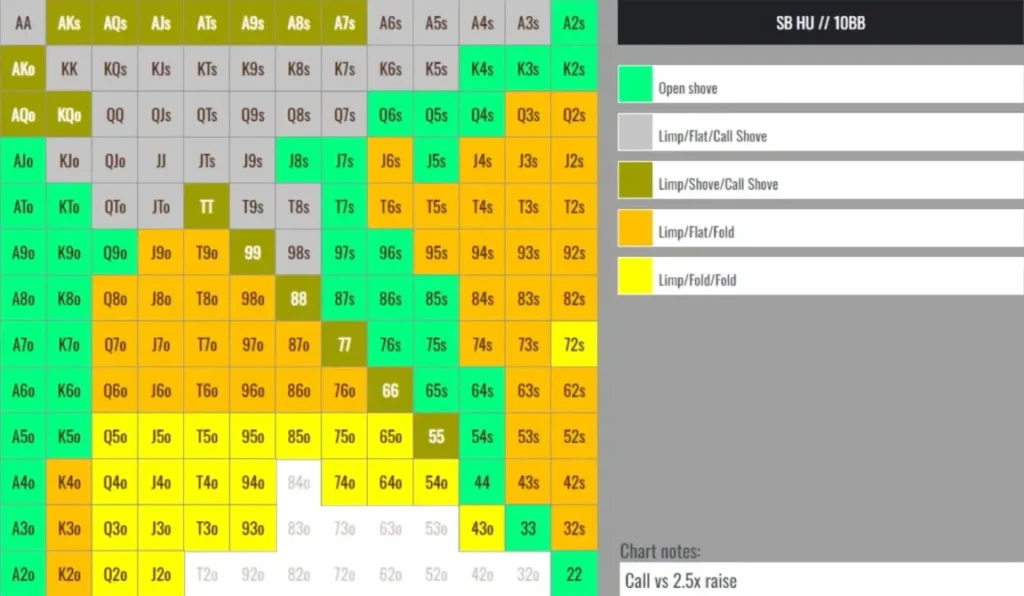
When stacks get as shallow as 10bb effective in a Spin & Go, you’ll start to open shove a lot more hands from the button, such as 22-44/A2o+/K5o+/K2s-K4s and some suited connectors.
Still, you might be surprised to see that this range still consists of a lot of limps. You can still limp premium hands such as JJ-AA to limp-call as a trap, as well as hands like A7s – AKs and medium pocket pairs to limp-shove all in.
You’ll also still be able to limp-fold your weakest combinations and limp-call a bunch of suited and offsuit hands to play in position, which means your overall range is still extremely wide with 10bb on the button. Study the chart below to get a feel for this stack depth:
Next Lesson…
This week’s lesson has focused on playing heads-up from the button with various common stack depths in Spin & Gos. Using the simplified charts presented, you’ll get a feel for the patterns of ranges and why certain hands work well as raises or limps.
The next Spin & Go Lesson will dig into heads-up play when you are out of position in the big blind, looking at when to call a raise, raise over a limp, or play for stacks.


View Other Blogs