
Casino Icons: Origins and Meanings
Visually appealing and eye-catching icons are everywhere in both land-based and online casinos.
In fact, players are so accustomed to seeing them that they recognise an icon’s meaning or significance without ever thinking about how it came to exist.
Well, below we put some of casino gaming’s most well-worn icons under the microscope, to find out exactly what they mean and where they originated. Knowing the origins of some of these icons may allow players to view casino games in an entirely different light, as they realise that there is much more than meets the eye where casino iconography is concerned.
The Playing Card Suits: Hearts, Diamonds, Clubs, and Spades
Perhaps the most recognisable icons in all of gaming, the four playing card suits have been around for centuries and are now synonymous with poker, blackjack, and baccarat. But their origins are far older than the casino world itself.
The suits we know today, hearts, diamonds, clubs, and spades, originated in 15th-century France, replacing earlier systems used in Italy and Germany. Each symbol carried a social meaning at the time:
- Hearts represented the church and the clergy.
- Diamonds stood for merchants and wealth.
- Clubs (originally clovers or batons) symbolised peasantry and agriculture.
- Spades (from the Italian word spada, meaning sword) represented nobility and military.
These suits were not only symbolic but practical. They made printing decks simpler and easier to produce in large quantities. Over time, they became universally adopted, crossing borders and eventually becoming core elements in casino games.
Today, these suits have lost their original class associations but continue to represent luck, fortune, and the nature of chance and risk.
The Number Seven: A Universal Symbol of Luck
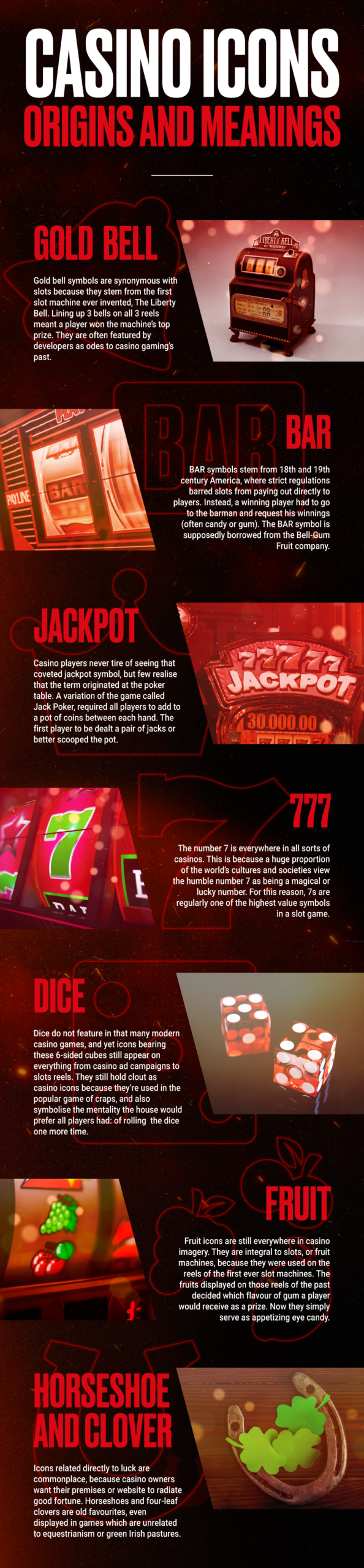
Across every casino game, the number seven is revered as the symbol of good luck. Whether it’s flashing across slot reels or appearing on a roulette wheel, seven has long been associated with fortune.
Its history traces back to cultures and religions, where seven was seen as a divine or mystical number. This is also down to the seven days of the week, the seven wonders of the ancient world, and the seven heavens in various mythologies. In Christianity, it represents perfection and completion.
When early slot machines were created in the late 19th and early 20th centuries, designers incorporated the number seven as a sign of good luck. The trend stuck, and it became a universal casino icon.
Even today, hitting a “777” combination on the reels is one of the most satisfying and rewarding moments in casino play.
The BAR Symbol: From Chewing Gum to Casino Floors
Another popular symbol found on slot machines is the BAR. However, few players know its surprising origin.
The BAR symbol originated from the Bell-Fruit Gum Company in the early 1900s. At the time, gambling was restricted, so slot machines often dispensed chewing gum rather than cash prizes.
The gum company’s logo was a stylised bar representing a slab of gum and was used as a symbol on the reels.
Over time, this design became iconic, and even when gambling laws changed and machines started offering real money, the BAR symbol stayed. Today, it’s an integral part of classic slot machine tradition, appearing alongside classic fruit symbols like cherries, lemons, and plums.
The Bell and the Liberty Legacy
Before modern slot machines, there was The Liberty Bell. The very first mechanical slot was created by Charles Fey in 1895. The Liberty Bell symbol, featuring the cracked American icon, was used to represent the machine’s jackpot.
The sound of a bell ringing became synonymous with victory and big wins, and this tradition continues today. In online slots, a winning spin is punctuated with that unmistakable “ding-ding”.
The Liberty Bell paved the way for an entire genre of gaming, and its imagery still resonates through casino design.
Fruits of Fortune: Cherries, Lemons, and Melons
Fruit symbols are another fixture of classic slot machines. These symbols originated around the early 1900s as a way to disguise gambling machines as fruit dispensers during periods when cash gambling was banned.
Players would win fruit-flavoured chewing gum corresponding to the images on the reels, which would be cherries, lemons, oranges, and so on.
The fruit stuck and evolved into a beloved part of slot culture. Today’s fruit-themed games often use vibrant symbols for nostalgia and because they are instantly recognisable.
The Joker: Trickster and Wildcard
No exploration of casino icons would be complete without the Joker. This mischievous card has roots in American card decks of the 19th century, where it was introduced as a special card for the game of Euchre.
Over time, it evolved into the wildcard, capable of standing in for any other card in many casino games.
The Joker’s symbolism represents both chaos and opportunity, risk and reward. In slot games, it often appears as a “wild” symbol, helping players complete winning combinations.
Final Thoughts
Casino icons are more than just colourful images designed to attract attention. They’re visual symbols of luck, heritage, and culture.
From the mystical allure of the number seven to the humble beginnings of fruit symbols and BAR logos, each icon tells a story that connects modern gaming to its historical roots.
Next time you spin the reels or play cards, take a moment to appreciate the legacy behind those familiar symbols. They remind us that while casino gaming has evolved, the icons of luck, risk, and reward remain timeless.

Top Content

Trending